
KuCard, the Visa debit that lives inside your KuCoin account
 Available in US
KuCard is a Visa debit card tied to the KuCoin exchange, marketed to people who already keep funds in that platform and want a card rather than a withdrawal. The story it tells on the surface is simple: convert crypto, tap to pay, walk away. The story underneath is more constrained, and the constraints are what most people run into first. I went through the card’s own terms, the KuCoin help center, third-party card directories and user feedback, and I want to walk you through what is actually on offer, what it costs in practice, and where the gaps are. The conditions described here are current as of 2026-10-20.
Conditions are current as of October 28, 2026.
Verdict
If I had to give the card a single number, it would land at 6.0 out of 10. That is not a flattering score and it is not a damning one. It reflects a product that does what it says within a narrow lane, and a narrow lane is exactly the problem for most readers.
KuCard suits a fairly specific reader: someone who lives in the European Economic Area, already has a verified KuCoin EU account, and wants to spend from a crypto balance in euros without going through a separate wallet or a separate exchange. For that person, the card is functional, the issuer is regulated, and the in-euro payments are free. For everyone else, the card is harder to justify. If you are outside the EEA, the door is closed. If you do not already use KuCoin, the card adds friction rather than removing it. If you are looking for cashback in line with the best crypto cards on the market, you will be disappointed.
The breakdown below tells you how that 6.0 splits across the dimensions that matter.
| Criterion | Mark | Why it earns that |
|---|---|---|
| Who can get it | 5 / 10 | Citizens and residents of the EEA only, with an EEA-issued ID, and not available in Malta. |
| Cost | 6 / 10 | The first virtual card is free, but the second and later virtual cards and the physical card carry fees, and non-euro payments are charged at 2%. |
| Top-up options | 4 / 10 | Funded from crypto on the KuCard account, USDT by default, and the list of coins and networks is not published. |
| Reliability and complaints | 7 / 10 | The issuer is Wallester AS in Estonia, supervised locally, and complaints about the card itself are very few. |
| Everyday use | 8 / 10 | It is a Visa, virtual or Chip-and-Pin physical, and unofficial sources say it works with Apple Pay and Google Pay. |
Who they will give the card to
The eligibility rule is one of the stricter ones I have seen for a crypto card. KuCard is available only to citizens and residents of the European Economic Area, with the additional note that it is not available in Malta. The card’s own terms allow the EU member states plus Iceland, Liechtenstein and Norway, and you also need an ID issued by one of those EEA jurisdictions. So if you are a French citizen living in Singapore, a British citizen in Berlin, or a US resident in Amsterdam, you do not qualify on the residence side and you do not qualify on the ID side. The same applies if you live in Malta, even though Malta is inside the EEA. The help page is explicit on that.
I find this unusual. Most crypto cards either chase the widest possible reach or pick a single country. KuCard has chosen to stay inside a regulatory perimeter that gives it a clear path to licensing, and that is a defensible choice, but it does mean that for a global reader this is a closed card unless you are in the right place with the right documents. If you are reading this from outside the EEA, you can stop here. If you are inside it, read on.
There is one more thing worth flagging. The terms frame the rule as “citizens and residents,” which is a higher bar than residence alone. So a non-EEA citizen who has permanent residence in, say, Germany may still not qualify if the issuer treats citizenship as the binding criterion. The card’s help page does not separate the two, and that ambiguity matters. If you are in this situation, ask KuCoin support before you put any time into the application.
How to get it
The signup path runs through the KuCoin EU platform, not through a separate card site. You start with a KuCoin EU account, complete the full KYC process using an EEA-issued identity document, get your address verified and confirm that you are at least 18. Once that is done, you apply for the card from inside the platform. There is no alternative onboarding path: you cannot open a card account first and verify later, and you cannot use the card without going through the same KYC the exchange itself requires for trading.
The card comes in two forms. The virtual card is issued immediately and you can use it as soon as it appears in the app. The terms also say it expires at the end of the month in which it was issued and you need to reapply for a new one, so the virtual card is best thought of as a short-lived instrument for a specific purchase rather than as a long-term wallet. The physical card is a Chip-and-Pin Visa debit that is posted to the address on file and activated in the KuCoin app or site once it arrives. You can hold up to five cards in total across the virtual and physical forms.
On rejection, the help center lists the usual reasons: an invalid phone number, a name or date of birth that does not match, an invalid 3-D Secure password, insufficient balance to cover the card fee, and risk control. None of those is unusual, but it is worth noting that an empty KuCoin balance can be a blocker at the moment of application, not only at the moment of payment. Processing time is not stated, so plan for a wait and check the app rather than expecting an email.
One more practical note on delivery. Standard delivery time and cost for the physical card are not stated in the published terms. The fee schedule lists an “Express Card Delivery” at €30 per card, which implies a faster option exists for those willing to pay, and a card replacement at €9.90 if the card is lost, stolen or damaged.
Fees: what it really costs
The fee schedule for KuCard has a few numbers that look generous and a few that look thin, and you only see the full picture once you put them together. The costs table below is built only from the fee schedule and the card’s published terms, and I have marked the items the card does not state openly as such.
| Fee or limit | Value |
|---|---|
| First virtual card | Free |
| Each further virtual card | €9.90 (fee schedule) / €9.99 (older support article) |
| Physical card (first) | €9.90 |
| Physical card (subsequent) | €9.90 (replacement) — second card fee not stated |
| Cancellation | Free |
| Express card delivery | €30 per card |
| Euro payments | Free |
| Non-euro payments | 2% of the transaction total |
| ATM within Europe | €2 per withdrawal |
| ATM outside Europe | 2% of the transaction total plus €2 |
| Declined payment (insufficient funds) | Free |
| Overdraft | Unavailable |
| Spending and ATM daily/monthly limits | Not stated in the public pages |
| Multi-currency balance | Not stated |
The two values for further virtual cards reflect a real inconsistency on KuCoin’s own pages: a more recent fee schedule lists €9.90 and an older support article still says €9.99. I would plan for the higher figure until KuCoin reconciles them.
A few real-life scenarios make this concrete.
You buy a €40 train ticket from a European rail operator that charges in euros. The transaction clears in euros, there is no FX leg, and the fee is zero. You then buy a €25 audiobook from a US store that charges in dollars. The card converts the euros to dollars at a rate KuCoin sets, and the card adds 2% on top of the transaction value. On €25 that is €0.50, and it is worth weighing against the conversion spread the issuer applies, which is separate from and additional to the 2% fee. The terms describe this as “a conversion spread” without giving a number, so the actual cost of a non-euro payment is the published 2% plus whatever KuCoin keeps inside the FX rate.
A third scenario is an ATM withdrawal in Spain. You pull out €100, the ATM operator’s own fee (if any) is added on top, and KuCard charges €2 for the withdrawal. Inside the EEA, that is the only charge; the FX line does not apply because the cash and the card balance are both in euros. Outside the EEA, the same withdrawal would carry the 2% international fee on top of the €2.
What I do not like is the silence around limits. Daily and monthly caps on spending and ATM withdrawals are not published, which means a reader cannot budget a trip or a salary run through the card without testing it in the app. That is a meaningful gap, and it is the kind of thing KuCard should publish if it wants to be compared on a level field with the alternatives.
Top up: how to add money to the card
Top-up is where KuCard’s narrowness shows the most. The card is funded from the supported cryptocurrency sitting in your KuCard account on the platform. USDT is the default spending currency, the rate is “solely determined by” KuCoin under the terms, and the card settles the payment in euros. That is the full picture on the public side. The list of supported coins and the list of supported networks are not published in a single table that I could find.
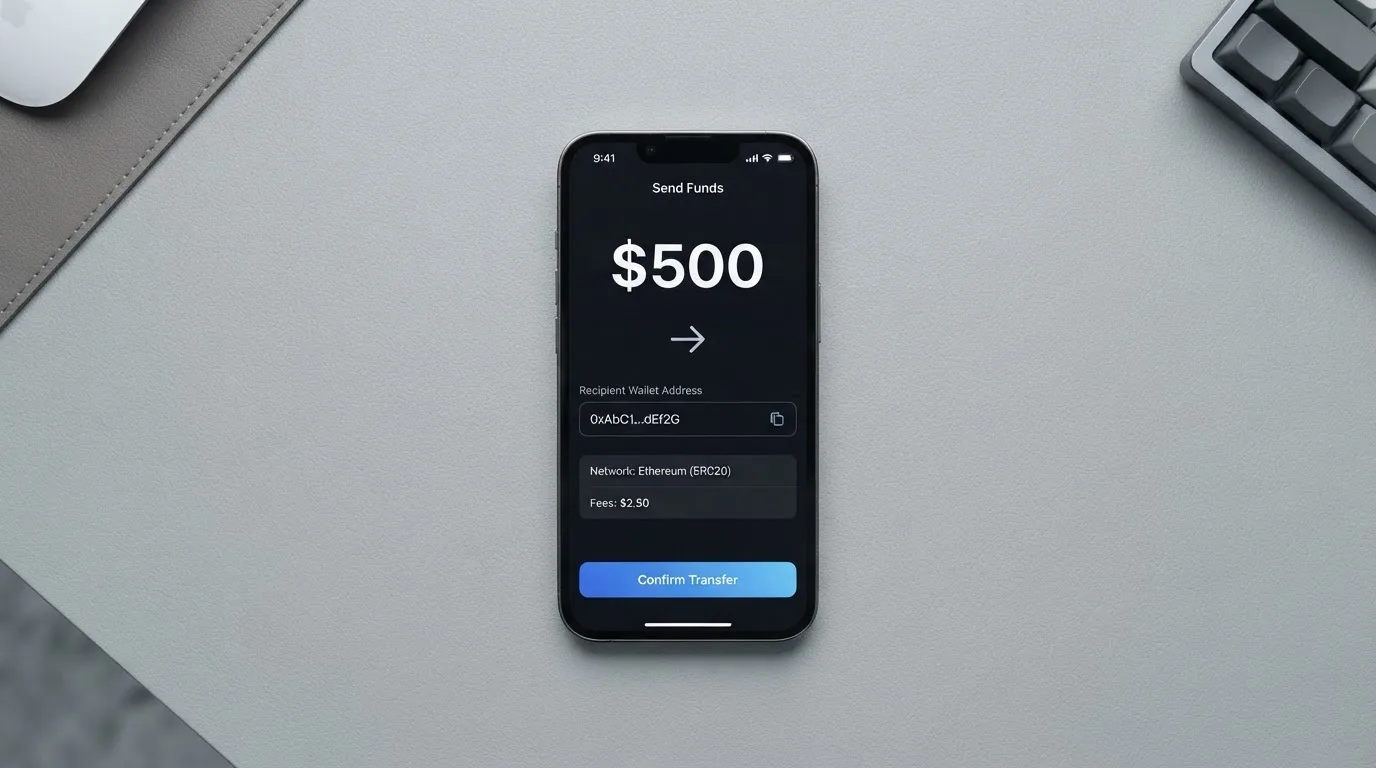
A practical implication: if you hold assets on the KuCoin platform in coins the card does not recognise, you will need to convert them first inside KuCoin before they can be used to fund the card. Another implication is that a user who holds Bitcoin or Ether and expects to spend them directly through the card will need to accept a second conversion step, with its own spread, on the way to a euro payment. The card’s own terms do not list a top-up fee as a line item, but they do reserve the right to apply “a conversion spread,” and they put the FX rate at KuCoin’s sole determination, which is the kind of language that lets an issuer keep some margin without disclosing it as a number.
Fiat top-up, minimum top-up amounts and who pays the on-chain network fees for a transfer are not stated. If you are moving USDT from another wallet to fund the card, the network fee is paid on the source side (it is the blockchain that charges it, not the card provider), but the receiving address and supported networks are exactly the kind of detail you want to confirm with support before sending anything, because a wrong network in crypto is usually a lost transfer.
The reverse question, getting money back out, is similarly underspecified. Cancelling a card is free, refunds are always paid back in fiat (euros), and a card that has never been activated may be closed after three months without refund of the service charges. A card may also be terminated after four consecutive months of being closed or blocked or after six months of non-use. What happens to any remaining balance on closure is not stated, and the right to move card balance back to crypto or to a bank is not stated. These are not problems in normal use, but they matter if you ever need to wind the card down.
Paying with it every day
The day-to-day experience of a KuCard is closer to a standard Visa debit than to a novelty crypto product, and that is the best thing about it. You can use it at any Visa-accepting terminal, online checkout or ATM. The physical card is a Chip-and-Pin, the virtual card is for online and in-app use, and you can hold up to five cards in total. The KuCoin app is the control surface: activation, freeze, replacement, transaction history, all live there.
Mobile wallets are where I want to flag a small caveat. The card’s own terms do not confirm Apple Pay or Google Pay support. Unofficial card directories and a 2024 PYMNTS piece say both wallets are supported, and that lines up with what most users would expect of a Visa debit in 2026, but I would not call this confirmed by KuCard itself. If the mobile wallet experience is the reason you are considering the card, verify in your own app before you commit to a paid physical card.
For rewards, the card’s terms only mention “different benefits or rewards from time to time” without giving a rate. Unofficial sources describe a tiered programme in USDC keyed to monthly eligible spend, with rates from 1% at the lowest level to 8% at the highest, points becoming available after 15 days and expiring after 90 days, and 1,000 points converting to 1 USDC. The same source also notes a €2 monthly inactivity fee on a virtual card after 90 days without a transaction. I treat both of these as unofficial. The terms are deliberately quiet on the specifics, and the absence of a published reward table is something I would want KuCard to fix.
On the dispute side, unauthorised transactions have to be reported within 60 days of the transaction date or they are treated as correct in the issuer’s eyes. Refunds come back in euros at the euro value of the original transaction, and processing time is not stated. Fees on the original transaction are not refundable. This is a workable but not generous policy: 60 days is shorter than some of the consumer-friendly cards in the category, and the absence of a stated refund processing window means a user cannot reliably plan around it.
What can go wrong
A card that is functional inside its lane still has risks, and the relevant ones here are not abstract.
Counterparty risk is the first one. The card is funded from your KuCoin account, which is a custodial platform. You do not hold the private keys, and the funds that back the card are sitting with the exchange. The history of the category is not reassuring: Mt. Gox in 2014, Coincheck in 2018 and the Ronin Network hack in 2022 each cost users hundreds of millions of dollars. KuCoin itself has had its own security incidents and has, like other large exchanges, drawn user complaints about withdrawal limits, dormancy fees and repeated identity demands at login. On Trustpilot, the KuCoin profile shows no TrustScore because the platform is currently in breach of Trustpilot’s guidelines, and of the 1,597 reviews 78% are one star, with the loudest themes being withdrawal and account restrictions, dormancy fees, P2P disputes and deposits not credited. Card-specific complaints are rare: I found one Trustpilot review from July 2026 about $120 stuck after the card on file expired, with the reviewer saying KuCoin asked for an old bank statement and the fees worked out to around €110. It is a single data point, but it is the kind of friction that hurts more on a card than on a one-off transfer.
Issuer risk is the second one. The card is issued by Wallester AS, an Estonian e-money institution supervised by the Estonian Financial Supervisory Authority. Wallester is a Visa principal member, which means it can issue Visa cards directly rather than through a sponsor. That is a stronger setup than a card programme riding on a smaller EMI, and the Estonian FSA is one of the more active national supervisors in the EU. None of that removes the underlying risk, but it sets a floor.
The third risk is operational. A virtual card expires at the end of the month it was issued, and the published card fees for replacements and additional cards are non-trivial. If you rely on the virtual card for subscriptions or recurring payments, the monthly reapplication is friction you have to plan around. A physical card replacement at €9.90 is also a meaningful sum for a small balance. And on sanctions and freezes, the terms require you to freeze your account “immediately” on the platform if the card is lost or stolen, which is faster than calling a bank but assumes you can reach the app and authenticate. Strong Authentication (two independent elements) is required for sensitive actions, 2FA is not specifically named, and unauthorised-use liability is capped at €50 unless the loss is from fraud or gross negligence on your side. There is no insurance.
The fourth risk is regulatory. MiCA’s transitional period runs until 1 July 2026, by which point crypto-asset service providers operating in the EU must have either received a MiCA authorisation or stopped operating under national grandfathering. The card’s own issuer is an EMI rather than a CASP, so the question of authorisation falls on the crypto side, on the KuCoin platform and on the Lithuania-domiciled entity UAB EURLITA that runs the virtual currency exchange. I have not seen a licence loss or a fine against the card, but the regulatory environment around crypto cards in Europe is still moving, and the user absorbs the consequences if a programme is wound down.
What to take instead
KuCard is not the only crypto card on the market, and the alternatives split into two camps: cards that reach a wider geography, and cards that compete in the same European lane with different trade-offs.
Bybit Card is a broader-reach option that explicitly does not serve EEA customers. It is available in regions including Argentina, the AIFC in Kazakhstan, Georgia, Australia, Mexico, Brazil, Peru and parts of Asia Pacific, with card currency pegged to local fiat (ARS, USD, MXN, BRL, PEN) and network depending on region (Mastercard in Argentina, AIFC, Georgia, Kazakhstan, Australia and Mexico; Visa in Brazil, Peru and Asia Pacific). Pricing is competitive on the issuance side: virtual cards are free in every region “until further notice,” physical issuance is free in Brazil and Mexico, and there are no annual fees. The cashback programme is generous, with a tiered structure that goes up to 10% on crypto-funded spending for the highest tier and a 30-day welcome offer of 10% cashback up to 110 USDT. The trade-off is geography: if you live in the EEA, you cannot use this card.
Coinbase Card is the US option. It is a Visa prepaid debit, virtual or physical, available in every US state except Hawaii, with zero spending fees, no annual fees and a spread applied at conversion. Rewards are paid in rotating crypto, the rate is shown in the app, and the card funds from cash or from any crypto on the Coinbase account. For an American reader, this is the card to compare against; for anyone outside the US, it is not available.
OKX is the closest direct competitor for a European reader. The card launched in the EU and Norway on 28 January 2026, is a Mastercard virtual debit in euros linked to OKX Pay, and is issued through a European licensed payment provider. There is no card fee, no transaction fee and no OKX FX fee; the conversion spread is given as 0.1% by a May 2026 explainer (against 0.4% in the original launch press release, with the explainer being the more recent figure). Funding is from USDC or USDG held in OKX Pay, with other coins requiring conversion first. The cashback structure is in EUR with caps and tiers that scale with VIP status, plus a launch promo of up to 20% back for VIP users. The key difference is the funding model: OKX is built around a stablecoin wallet, KuCard is built around a KuCoin exchange account. If your portfolio is mostly stablecoins, OKX is more direct. If you are already a KuCoin customer with a mix of assets, KuCard is.
| Card | Score | Where it works | Card fee | Foreign-use fee | Cashback |
|---|---|---|---|---|---|
| KuCard | 6.0 | EEA (not Malta) | First virtual free, then €9.90 | 2% | Unofficial, up to 8% in USDC |
| Bybit Card | 6.0 | Argentina, AIFC, Georgia, Kazakhstan, Australia, Mexico, Brazil, Peru, parts of Asia Pacific (no EEA) | Virtual free, physical varies | 1%–2% (Argentina 7%) | Up to 10% on crypto-funded |
| Coinbase Card | 6.4 | US (all states except Hawaii) | None | Spread-based | Variable, in rotating crypto |
| OKX | 6.2 | EU and Norway | None | 0.1% conversion spread | Up to 10% (VIP4+) |
Who I would recommend it to
I would recommend KuCard to a fairly narrow reader, and I would steer most other readers toward one of the alternatives above. The right KuCard reader is an EEA resident (outside Malta) with a verified KuCoin EU account, who keeps a meaningful balance on the platform, spends mostly in euros and values the simplicity of paying directly from that balance over the higher cashback available elsewhere. For that reader, the card is a convenient bridge from the exchange to the real world, the issuer is properly supervised, and the in-euro payments are free.
I would not recommend it to a reader who is not in the EEA. The eligibility rule is too tight to make it worth the application effort, and you will be turned away at KYC. I would also not recommend it to a reader who does not already use KuCoin. The card does not have an identity of its own, and the onboarding friction is higher than a standalone card because it is bundled into an exchange account you would otherwise not need. And I would not recommend it as a primary spending card to a reader who travels outside the eurozone often: the 2% non-euro fee plus the unpublished conversion spread is a real drag, and the daily and monthly limits are not public, which makes budgeting harder than it should be.
If you are inside the EEA and you want a card you can fund from crypto without the friction of a separate stablecoin wallet, KuCard is worth a closer look. If you want better cashback, broader reach or a more transparent fee model, look at the alternatives before you commit. The card is functional. It is not exceptional.
Frequently asked questions
What is KuCard?
KuCard is a Visa debit card issued by Wallester AS in Estonia and operated in partnership with the KuCoin exchange. It converts a supported crypto balance on the KuCoin EU account into euros at the till, and it comes in virtual and Chip-and-Pin physical forms.
How does KuCard work?
When you pay, the card debits your KuCard account, sells your default crypto (USDT) for euros at a rate set by KuCoin, and settles the payment in euros. Non-euro payments are converted again at the point of sale and carry a 2% foreign-use fee.
Is KuCard a bank?
No. The issuer is Wallester AS, an electronic money institution licensed in Estonia and supervised by the Estonian Financial Supervisory Authority. The card is not a bank account, and the funds are not covered by a deposit guarantee scheme.
Who owns KuCard?
The card is operated by the KuCoin platform under a partnership with Wallester AS as the issuing bank. UAB EURLITA, a Lithuania-based entity, operates the virtual currency exchange and deposit side of the service on the platform.
Is KuCard available in my country?
It depends on whether you are a citizen and resident of the European Economic Area, with an EEA-issued ID, and whether you live in Malta (where the card is not available). The list of permitted jurisdictions is the EU member states plus Iceland, Liechtenstein and Norway. Citizenship and residence rules are applied, so check both before applying.
How do I apply for KuCard?
Open a KuCoin EU account, complete the full KYC with an EEA-issued ID and address verification, confirm you are at least 18, and apply for a virtual or physical card from inside the platform. The virtual card is issued immediately; the physical card is posted to your address.
How do I top up KuCard?
The card is funded from the supported crypto held in your KuCard EU account. USDT is the default spending currency. The list of supported coins and networks is not published in a single public table, so confirm with support before transferring from an external wallet.
Can I add KuCard to Apple Pay or Google Pay?
Unofficial sources and a 2024 PYMNTS piece say yes, but KuCard’s own terms do not confirm mobile wallet support. Verify in your own app before relying on it, especially before you pay for the physical card.
Is KuCard safe?
The issuer is a regulated Estonian EMI and a Visa principal member, and the card supports Strong Authentication, instant freeze from the app and a €50 cap on unauthorised-use liability outside of fraud or gross negligence. The platform side is custodial, so the usual exchange counterparty and hack risks apply. Card-specific complaints are very few, but complaints about KuCoin the exchange on Trustpilot are heavy and worth reading before you fund the card.
How do I close my KuCard account?
Cancelling a card is free. The terms also allow the issuer to close an unactivated card after three months or a card that has been blocked or unused for four to six months, and the rules around returning a remaining balance on closure are not stated. If you want to wind the card down, contact KuCoin support in writing and ask about the return-of-balance process before you start.
Exchange cards – cryptocardsearch.com
Content created by the «cryptocardsearch.com» team