
Tap scores middling: good daily card, thin disclosure, and reviews that keep repeating the same problem
 Available in US
Tap is one of those crypto cards that behaves like an ordinary prepaid card rather than a crypto wallet. You load a balance, and then you spend it wherever a card is accepted. On paper that is exactly what many people in places where a normal bank card is awkward or impossible want. The problem is not the idea. The problem is how little the public pages say, and what the people who already use it keep writing about.
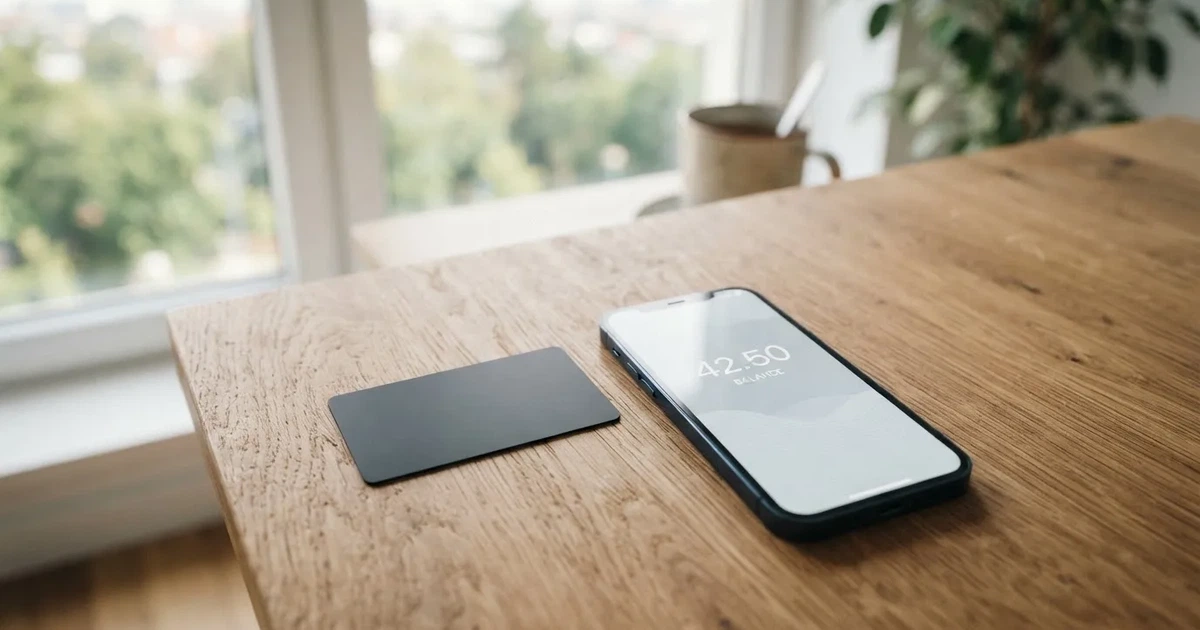
My score for Tap is 5.6 out of 10. That is not a rejection. It is a card that works well enough for daily spending, that appears to have no monthly fee, that pays cashback, and that comes with a Gibraltar licence and a stated 400,000 customers — wrapped in a fog of unpublished country lists, unpublished fees, and a review record in which frozen accounts keep appearing. Let me take you through what I checked, what I found, and where I would draw the line.
The conditions described here are current as of October 28, 2026.
The verdict: 5.6 out of 10
Tap gives you a Mastercard, a crypto balance you can convert into spending money, and cashback up to 8%. That is a real, usable product for a specific person: someone who holds crypto or stablecoins, wants a card rather than an exchange account, and lives somewhere the card actually works. For that person it is a sensible tool.
It is a worse fit for almost everyone else, and worse still for anyone whose income arrives in fiat and who just wants a straightforward, low-cost debit card. The disclosure is thin enough that you cannot check the fees from the card’s own site. The customer reviews mention accounts frozen for days and weeks. And the card’s own pages do not publish the one list you most need before you apply: where it works.
Here is the score broken into the parts I actually assessed:
| Criterion | Mark | Why |
|---|---|---|
| Who can get it | 6 / 10 | No country list published; the site only says services “may not be available in all jurisdictions” and to verify eligibility in your region |
| Cost | 6 / 10 | Nothing official disclosed; unofficially the monthly fee, issuance, top-ups and ATM use are free, FX 1.5%, with reports of a $35 withdrawal fee and an inactivity charge |
| Top-up options | 5 / 10 | No coin list published. Stablecoins, USDT, BTC and SOL are mentioned, plus a bank/crypto on-off ramp; unofficially crypto must be converted before it reaches the card |
| Reliability and complaints | 4 / 10 | Tap Global Limited (Gibraltar), Gibraltar FSC DLT licence No. 25532, Moorwand Ltd named as issuer for the new card; Trustpilot 3.4 out of 5, with frozen accounts lasting days and weeks and withdrawal delays |
| Everyday use | 7 / 10 | Physical and virtual Mastercard; Apple Pay and Google Pay are marked supported unofficially, though one source’s cons say no Apple Pay; ATM withdrawals reported free |
| Total | 5.6 / 10 | A competent daily card held back by disclosure and by a complaints record that repeats itself |
The intended audience, for what it’s worth, is people who want crypto, currency accounts and cashback in one place. If that is you, keep reading. If you are choosing between this and a plain bank card, the comparison at the end will tell you quickly.
Will they give you the card?
Short answer: I cannot tell you from the card’s own website, and neither can you.
The site publishes no country list. What it publishes instead is a warning — services may not be available in all jurisdictions — and an instruction to verify your eligibility in your region. That is the whole of it. No count of countries, no names, no residency test, no citizenship test.
This matters more than it sounds. KYC rules require regulated businesses to verify customers as part of anti-money-laundering law, and in the EU that due diligence covers your name, address, date of birth, nationality and identity documents, plus a sanctions check. If due diligence cannot be completed, EU rules require the institution to refrain from the transaction or relationship and, where necessary, close the relationship. Accounts get frozen pending documents. That is not a quirk of Tap; it is the law the issuer operates under.
Nationality is also recorded and screened separately from residence, because sanctions screening is usually applied to citizenship and country of birth as well as to your address. So a card that works for a resident of one country may still be closed on a citizen of another.
Two practical points before you spend an evening on an application you may not finish. First, the card is aimed at adults; prepaid and debit cards are generally available to 18 and over, and some issuers set higher limits. Second, an unverified account is worse than no account, so have your identity document ready before you start rather than after you are asked.
What identity checks actually apply
The card’s public pages say nothing about what verification level you will face. Not stated: whether a proof of address is needed, whether a selfie is taken, which documents count.
What a third-party card comparison site reported for 2026 is more specific but unofficial: email, phone and identity document, with no proof of address and no selfie required. Treat that as a useful pointer to what to have ready, not as a promise. Providers change these requirements, and stricter regimes often demand more. The authoritative answer is whatever the app asks you for on the day.
How to get it
What is confirmed is thin, and what is not confirmed is thinner. The card is physical and virtual, and it is a Mastercard — the site shows a dark-finish Tap Mastercard. The currency of the card is not stated, which turns out to matter a great deal, and I will come back to it in the costs section.
Delivery is not stated: no timeframe, no shipping charge, no regions. Nor are the KYC levels.
Registration and verification steps are not stated either. What a third-party site reported unofficially for 2026: email, phone and identity document, with no proof of address and no selfie. That is the shortest path anyone has described, and it is not confirmed by the card.
One point worth pausing on, because it will decide whether you are even eligible: Tap publishes no country list at all. You cannot check from the site whether residents of your country can apply, and you cannot tell whether the restriction is on citizenship or on residence. If your situation is unusual — you are a citizen of one country living in another, for example — you may only find out by going into the app. Expect to lose some time on that.
There is also a structural change worth knowing about. On 5 October 2026, Tap Global Group PLC appointed Moorwand Ltd as issuer and BIN sponsor for a new multi-currency Tap Mastercard, replacing the euro card. The CEO cited 400,000 customers. If you are opening an account around that transition, the card in your hand may not be the card you read about.
Fees: what it really costs
Here is the blunt finding: the card’s own pages do not disclose its fees. Issuance is not stated. The monthly fee is not stated. Conversion and FX figures are not stated. ATM charges are not stated. Limits are not stated. There is not even a “Zero” claim to lean on. Everything below therefore comes from a third-party card comparison site and is unofficial, and I mark it as such.

| Fee or limit | What is stated by the card | Unofficial reports (2026, month not shown) |
|---|---|---|
| Issuance | not stated | Free |
| Monthly fee | not stated | Free |
| Inactivity | not stated | Reported by users as a charge |
| Crypto-to-fiat conversion | not stated | Crypto must be converted before loading the card |
| FX / non-home currency | not stated | 1.5% |
| ATM withdrawal | not stated | Free and unlimited |
| Declined payment | not stated | Not stated |
| Cash withdrawal from balance | not stated | User reports of a $35 withdrawal fee |
| Daily spend limit | not stated | One source says “Unlimited”; another cites a 15,000 EUR daily cap |
| Monthly limit | not stated | not stated |
So the honest summary of the cost picture is this: the recurring costs look, to the best of available reporting, like zero, and the transaction costs are a 1.5% foreign-exchange charge plus whatever the underlying conversion costs you. Two things cut the other way. The withdrawal fee reports, if accurate, are large enough to matter if you ever treat the card as a way to get cash out rather than spend. And the limits row is a straight contradiction between two unofficial sources, which tells you nobody outside the app knows them either.
The limits are exactly why I would not put a large balance on this card without opening the app first and reading them. That is not a how-to for circumventing anything. It is the same advice I would give for any prepaid instrument.
The euro problem, and the multi-currency fix
This is the single most important thing to understand about Tap, and it is the piece most reviews skip.
Tap says the existing card is euro-denominated, and that other currencies are converted at the point of sale. So if you are paid in dollars, pounds, or anything else, your balance passes through a conversion every time you spend — and the rate you get is the rate the issuer applies on the day, with the 1.5% reported as the FX fee sitting on top of whatever spread is embedded.
On 5 October 2026 the company announced a new multi-currency Mastercard that spends from app balances directly, with Moorwand Ltd as issuer and BIN sponsor. No launch date was given. So for now, if you are outside the euro area, the arithmetic of every purchase includes a conversion you did not choose. That is not automatically bad — if you hold stablecoins anyway, converting at the point of sale is arguably the only conversion you needed. But it does mean the 1.5% figure is not a footnote. On daily spending it is the number that decides whether the card is worth keeping.
Three ordinary payments, and what applies to each
Payment one — coffee in a euro-area city. The card is euro-denominated, so no conversion is involved. If cashback applies, up to 8% comes back, with the entry level reported unofficially at 0.5%. No fee is expected at all. This is the case the product is built for.
Payment two — a subscription billed in dollars, while your balance is in euros. This is where the 1.5% FX charge earns its place. The amount is converted at the point of sale, the issuer’s rate applies, and the fee is charged on top. Repeat that on a monthly subscription and you can work out for yourself what a 1.5% drag does to the annual total. This is the case where Tap is quietly expensive, and where the announced multi-currency card would change the answer.
Payment three — withdrawing cash from an ATM. Unofficial reporting says ATM withdrawals are free and unlimited. The same reporting says a $35 withdrawal fee appears in user accounts. Those two statements cannot both describe the same action, so the sensible reading is that free ATM withdrawals from the card balance and a fee on moving funds out of the account are being conflated. If cash access matters to you at all, this is the question to put to support before you rely on it.
One more everyday cost that is not in any fee table: network charges. If you fund the card by sending crypto on-chain, the gas or bandwidth is charged by the blockchain, not by Tap. On Ethereum that means holding a little ETH, because fees are paid only in ETH — a wallet with USDT and no ETH cannot send.
How to top it up
The card publishes no funding list. What its pages mention is stablecoins, USDT, BTC and SOL yields, and a Bitcoin on-and-off ramp between your bank account or wallet and crypto, available at any time. Networks are not stated, fees and minimums are not stated.
Unofficially, and this is the part that trips people up: crypto must be converted before it is loaded onto the card. This card does not spend your coins. It spends a balance. That is a meaningful difference from self-custody-linked cards, where funds stay in your own wallet until the moment of payment. With a pre-loaded balance you are trusting the provider with whatever sits in the account, and the provider has a record worth reading in the risks section below.
The same third-party source is internally inconsistent about the range of supported coins — showing 48 in one place and 0 in another — which is another reason to read the app’s own deposit screen rather than a comparison site.
Separately, Tap mentions dedicated IBANs to hold seven national currencies, and a bank or wallet to crypto on-and-off ramp. The on-and-off ramp is described as available between a bank account or a wallet and crypto “at any time”. What happens to your balance if the account is closed — whether it is returned, converted, or how long you have to withdraw it — is not stated. That is worth asking about, because programme closures follow a pattern: a notice period, then loading and spending stop, then users are asked to withdraw what is left. One 2026 closure reported by a secondary source ended new loads on 8 July 2026 and spending on 8 August 2026; that is a single unconfirmed source, but the sequence itself is not unusual.
What happens if you send the wrong thing
Blockchain transfers are irreversible. A deposit sent on a network the provider does not support, or to an address belonging to a different network, can be lost or need manual recovery with no guarantee of success. Since Tap does not publish which networks it accepts, this is not a hypothetical for a beginner — it is the first thing to verify, in the app, before you send anything at all.
Two further wrinkles if you plan to use stablecoins. USDT exists on several networks including Ethereum, Tron, Solana, Polygon and Avalanche; sending on the wrong one is the classic way to lose a deposit. And USDC over TRC20 is not a native option — Circle stopped supporting USDC on Tron in February 2024, so that route does not exist to use. Circle lists USDC as natively supported on 38 networks as of 16 September 2026, including Ethereum, Solana, Base, Polygon PoS, Avalanche, Arbitrum and Stellar.
Do read the deposit screen in the app for the current list, because a provider can change supported networks and there is no published page to check against.
Paying with it every day
Used as a payment card, Tap is the part that works. Physical and virtual Mastercard, a euro-denominated card with other currencies converted at the point of sale, and cashback “up to 8%” on qualified purchases. What the cashback is paid in, what the tiers are, and whether there is a cap: not stated. Unofficially, cashback runs up to 8% with VIP tiers and an entry level of 0.5%.
Where you can pay is unremarkable, and that is a compliment. A Mastercard is a Mastercard. But there are three real-world friction points worth understanding.
Declines. A card number starts with a 6- or 8-digit issuer identification number that tells the merchant which institution and country issued it. Shops look that up, and some apply extra scrutiny when the issuer country differs from the billing address. That is why a card issued in one country can look “foreign” in another, and why some merchants refuse prepaid or foreign-issued cards outright. Address verification — which compares the numeric parts of the billing address you type against issuer records — is generally unavailable for foreign-issued cards, which is a common cause of declines. If you travel, expect this.
Online payments and 3-D Secure. For online purchases the issuer may add an identity check, approving frictionlessly or challenging you with a one-time code or biometric. Visa’s brand is Visa Secure, Mastercard’s is Identity Check. The same authorisation system can leave a hold on your funds for several days, typically up to seven, even when the payment itself fails.
Blocked categories. A merchant category code is a four-digit number classifying a business by goods or services. Gambling is 7995, and many issuers block it by policy rather than by law, with the list differing from issuer to issuer. Tap does not publish its blocked codes, so you cannot check in advance whether a given purchase will work. It is one more thing you find out at the till.
Apple Pay and Google Pay. The card’s own pages say nothing. A third-party site marks both as supported, while the same site’s cons say “No Apple Pay support”. Unresolved. Apple Pay works by replacing the card number with a device-specific number stored in the phone’s secure hardware and issuing a one-time code per payment; an issuer can restrict that token for specific channels. Whether Tap lets you add it is a two-minute check in your own wallet app, and it is worth doing before you travel.
The app. On the App Store: 4.5 out of 5 from 25 ratings, version 3.8.8, requiring iOS 15.6 or later, as read on 2026-10-20. That is a small sample — 25 ratings tells you very little — and the Google Play listing was not read. App languages are English, French, Greek, Italian, Spanish and Swedish. Support is advertised as available 24/7, though no channels are named.
Disputes. Not stated. The terms page did not load text. If something goes wrong with a payment, I cannot tell you from public sources what process you would be in, which reason codes exist, or how long it takes. Under EU rules a chargeback is a refund ordered by your issuer — fraud, duplicate billing, goods not received — and under 3-D Secure liability for a fraudulent online payment can shift to your bank. Whether that protection applies cleanly to a prepaid balance is exactly the kind of thing that gets decided in a dispute rather than in a brochure.
What can go wrong
Start with the reviews, because they are the most substantive thing available.
The company. Tap Global Limited, Gibraltar, company No. 118724, Madison Building, Midtown, Line Wall Road, Gibraltar GX11 1AA. Licensed by the Gibraltar FSC under the DLT Regulatory Framework, Licence No. 25532. Banking and e-money services are provided by “Our Authorised Issuing Partners”; the specific provider is shown in the app and varies by region, currency and account type, and the issuer’s name is not stated on the site. Tap Global itself says it is “not a bank”.
That distinction matters. An e-money institution can issue e-money and payment cards but cannot lend, and it must safeguard customer funds in segregated accounts or with insurance — but those funds are not bank deposits and are not covered by a deposit guarantee scheme. If the provider behind the app fails, you are a creditor of an e-money institution, not a depositor with a guaranteed balance.
The ratings. Trustpilot tap.global: 3.4 out of 5 from 321 reviews, 36 of them in the last 12 months, as read on 2026-10-20. Another reading of the Trustpilot UK page gave 3.5 out of 5 from roughly 309 undated reviews. Either way, this is not a high score, and it is a large enough sample that I would not write it off as a handful of angry users.
What people actually write. Accounts frozen or locked for days to weeks without explanation, reported between December 2025 and February 2026. Deposits and withdrawals that never arrived, reported in January, June and September 2026. Inactivity or monthly fees draining balances, April to June 2026 — which sits awkwardly beside the “no monthly fee” claim. Slow support at weekends. A revoked referral bonus. A high crypto withdrawal fee. Tap’s response is that fees are set out in its terms.
A note on why freezing happens at all. When an institution cannot complete due diligence, it is required to hold off. Users with foreign addresses, mismatched document details or documents that expire can be caught in this. It is lawful and it is not malice, but from the outside it is indistinguishable from an account that simply stopped working, and the review pattern above shows how it lands.
What is not stated. Two-factor authentication: not stated. Insurance or any fund protection scheme: not stated. Dispute process: not stated. Country list, fee list, limits, delivery times, KYC requirements, blocked merchant categories: all not stated. That is a long column of not stateds, and each one is a question you would otherwise answer for free.
Risk inherited from the category. Card programmes have been ended before. Visa terminated its global agreements with FTX on 13 November 2022 and the FTX US debit card was wound down. WaveCrest, a Visa issuer that supplied crypto card brands, was suspended by Visa in Europe in 2018, closing all WaveCrest-issued Visa programmes. Visa and Mastercard do not issue crypto cards to consumers themselves — they license issuers, and they can suspend a programme. If you hold a balance, that is the tail risk nobody can price for you.
Regulation to know about. Under MiCA, the EU’s markets-in-crypto-assets regulation, e-money tokens may be issued only by a credit institution or an electronic money institution. The rules on stablecoins applied from 30 June 2024 and the remaining provisions, including crypto-asset service provider rules, from 30 December 2024. Transitional arrangements run until 1 July 2026 or until a provider receives or is refused authorisation, whichever comes first, and ESMA maintains an interim register of authorised providers you can check. Note also that the card is regulated separately from the crypto side — a crypto card often rests on two licences at once.
Tax. The IRS treats digital assets as property, so exchanging them for goods or dollars generally produces a taxable gain or loss, measured in local fiat currency at the fair market value on the date of the transaction — meaning each card payment funded from crypto may be a separate disposal. Rules differ by country and I am not qualified to advise on yours; a card payment that looks like spending money can be a taxable event underneath.
What to take instead
If you want to compare rather than commit, these are the alternatives I weighed, with their own scores.
| Card | Score | Who it works for | Where it hurts |
|---|---|---|---|
| RedotPay | 6.9 / 10 | People who want a published fee list and a stated country policy | Long published exclusion lists; card issuance blocked for residents of 47 places including India, Indonesia, Morocco, Nepal, Singapore and Turkey |
| Wirex | 6.7 / 10 | Multi-region users who want cash, stablecoins and crypto on one card | Availability depends on region; fees published for UK, EEA, APAC, SG, AU and “Other”; Singapore terms bar cash withdrawals |
| Bitpanda | 6.5 / 10 | Euro-area residents who want to spend from crypto, metals or EUR in one balance | Euro-area residents only, and accounts verified via Bankident cannot order a card; EUR-only card |
| Tap | 5.6 / 10 | Euro-area or nearby users wanting crypto, currency accounts and cashback | No country list, no published fees, 3.4/5 on Trustpilot with frozen accounts reported |
Some differences are worth spelling out, because they are the difference between a card you can evaluate and one you cannot.
RedotPay publishes far more than Tap. It has two official lists that word the rule differently: a KYC list of unsupported countries and regions, and a card-issuance list dated 28 August 2026 with 47 places. The first says citizens of the listed countries cannot complete verification or use the service, and that restrictions are “based on local regulations and sanction policies—not on individuals”. The second says residents of India, Indonesia, Morocco, Nepal, Singapore and Turkey are ineligible for both virtual and physical cards and cannot be billing addresses, and does not mention citizenship. Russia, Belarus, Ukraine and Serbia are on both; Georgia, Armenia, Kazakhstan and the UAE are on neither. Its fees are explicit: virtual card application 10.00 USD, physical card application 100.00 USD and not refundable once paid, transaction fee 1.00%, non-default currency 1.20%, declined transactions 0.5 USD after three free a month, and a paid Pro tier at 12.90 USD monthly or 129.00 USD annual. More expensive, and far easier to check.
Wirex runs a card across 130+ countries with cash, stablecoins and crypto spending, cashback in WXT from 0.5% to up to 8% by tier, and card issuance free in its published regions — though a metal Visa Signature card costs 45 GBP on the UK page. Its cashback exclusions are spelled out in a way Tap’s never are: ATM withdrawals, cash advances, crypto purchases, gambling, refunds and a long list of merchant category codes.
Bitpanda requires residence in a euro-area country and a verified account, and explicitly excludes users verified through “Bankident”. The card is EUR-only, one active card at a time, reissue EUR 5.90. The non-EUR FX fee is EUR 0 but VISA mark-up fees apply, and the crypto conversion spread is not stated. Its cashback is stated two ways on its own pages — 1% in the body and “up to 2%” in a summary — which is a small honesty problem, but at least it is visible.
Each of those three costs you more up front than Tap apparently does. What they buy is disclosure. Tap’s advantage is cheapness and the cashback. Its cost is that you are making the decision with the lights off.
Who I would recommend it to
Tap earns its 5.6 from one group and one group only: you already hold crypto or stablecoins, you are in or near the euro area, you want to spend that balance without converting it yourself at an exchange, and you can live with a card whose provider has a 3.4 rating and a history of frozen accounts. If that is you — and you have read the app’s own fee and limit screens rather than trusting a review — it is a reasonable tool.
I would steer everyone else elsewhere. If your money arrives in fiat and you just want to spend it, a plain bank card or an ordinary e-money card will be cheaper, quieter and better understood. If you are outside the euro area, the currency conversion sits inside every single purchase until the announced multi-currency card actually ships. If you are considering it because you cannot get an ordinary bank card, understand that the Tap answer is not permanent: account blocks and programme closures are real, and this card’s terms about what happens to your balance on closure are not published.
Three things I would check before depositing anything, in this order: read the fee and limit screens in the app, because that is the only place the numbers exist; find out which networks the deposit screen accepts before sending a single coin, because transfers are irreversible; and keep only what you can afford to have locked for weeks, because that is what the reviews describe.
And if you are comparing cards on paper, check the exclusions before the features. Every card here has an eligibility rule; only some of them publish it. That difference turned out to matter more to my score than any cashback rate.
Frequently asked questions
What is the Tap card?
Tap is a crypto payment card: a physical and virtual Mastercard you fund from crypto or a currency balance and then spend like an ordinary card. It is issued by partners rather than by Tap Global itself, which says it is “not a bank”. The app also offers multi-currency IBANs and cashback of up to 8% on qualified purchases. It is aimed at people who want crypto, currency accounts and cashback in one place.
Is Tap a bank?
No. Tap Global Limited is a Gibraltar company licensed by the Gibraltar FSC under the DLT Regulatory Framework, Licence No. 25532, and it states plainly that it is not a bank. Banking and e-money are provided by authorised issuing partners, shown in the app and varying by region and account type. Funds sit as e-money safeguarded by that provider, not as bank deposits, so deposit guarantee protection should not be assumed.
How much does the Tap card cost?
The card’s own site discloses nothing — no issuance fee, no monthly fee, no FX or conversion figures, no ATM charge, no limits. Unofficial 2026 reporting says the monthly fee, issuance, top-ups and ATM withdrawals are all free, with FX at 1.5%, while users report a $35 withdrawal fee and an inactivity charge. Read the fee screen in the app before you rely on any of this.
Does the Tap card require KYC?
The public pages do not say what verification level applies. A third-party site reported for 2026 that it needs email, phone and an identity document, with no proof of address or selfie, but that is unofficial and not confirmed by the card. What is certain is that anti-money-laundering rules require verification regardless, and that if it cannot be completed the account will be held or closed.
Which countries can get a Tap card?
Nobody knows from public sources. The site publishes no country list, only a notice that services may not be available in all jurisdictions and a prompt to verify eligibility in your region. Whether the restriction applies to citizenship, residence or both is not stated. Contrast RedotPay, which publishes both a KYC exclusion list and a card-issuance list of 47 places.
How do I top up the Tap card?
The card publishes no funding list or networks. Its pages mention stablecoins, USDT, BTC and SOL, and a bank or wallet to crypto on-and-off ramp available at any time. Unofficial reporting notes that crypto must be converted before it lands on the card, since the card spends a balance rather than your coins. Check which networks the in-app deposit screen accepts before sending anything, as transfers cannot be reversed.
Can I use Tap card in Apple Pay or Google Pay?
The card’s own pages say nothing. A third-party site marks Apple Pay and Google Pay as supported while the same page’s cons say there is no Apple Pay support, so the answer is genuinely unresolved. It takes two minutes to check whether your wallet offers Tap as an issuer, and that is worth doing before you travel rather than at the till.
Is the Tap card safe and worth it?
Safe in the everyday sense — you can freeze the card or lock the account instantly and reveal the PIN in the app — but 5.6 out of 10 overall, because disclosure is thin and Trustpilot sits at 3.4 out of 5 from 321 reviews with reports of accounts frozen for days and weeks. It is worth it if you already hold crypto and live near the euro area; it is probably not worth it if you want a simple everyday debit card.
What happened to the euro card?
On 5 October 2026 Tap Global Group PLC appointed Moorwand Ltd as issuer and BIN sponsor for a new multi-currency Tap Mastercard to replace the euro-denominated card, and the CEO cited 400,000 customers. Spending from app balances in multiple currencies was announced with no launch date given. Until it ships, the old card remains euro-denominated and converts other currencies at the point of sale.
What happens to my balance if I want to close the account?
Not stated. The site describes the on-and-off ramp as available between a bank account or wallet and crypto “at any time”, but says nothing about closure, withdrawal windows, or whether a balance is returned or converted. Card programme closures typically follow a pattern — notice, then loading and spending stop, then withdrawal of remaining balances — so ask support directly rather than assuming your money stays put.
App and neobank cards – cryptocardsearch.com
Content created by the «cryptocardsearch.com» team