
Brighty scores 5.6 out of 10: the crypto IBAN is the product, the card is the accessory
 Available in US
Brighty is not really a bank and it does not pretend to be one. It is a financial technology company that pairs a crypto wallet, a euro IBAN and a payment card into one app, and the pitch is simple: hold Bitcoin or stablecoins, get a card number and an IBAN, spend from it anywhere cards are accepted. The appeal is obvious to anyone who has wanted crypto to behave like ordinary spending money rather than a separate, awkward thing. So I read the card’s own pages closely — the card page, the help centre, the fees and plans articles — and compared them with what reviewers actually report and with the three closest alternatives.
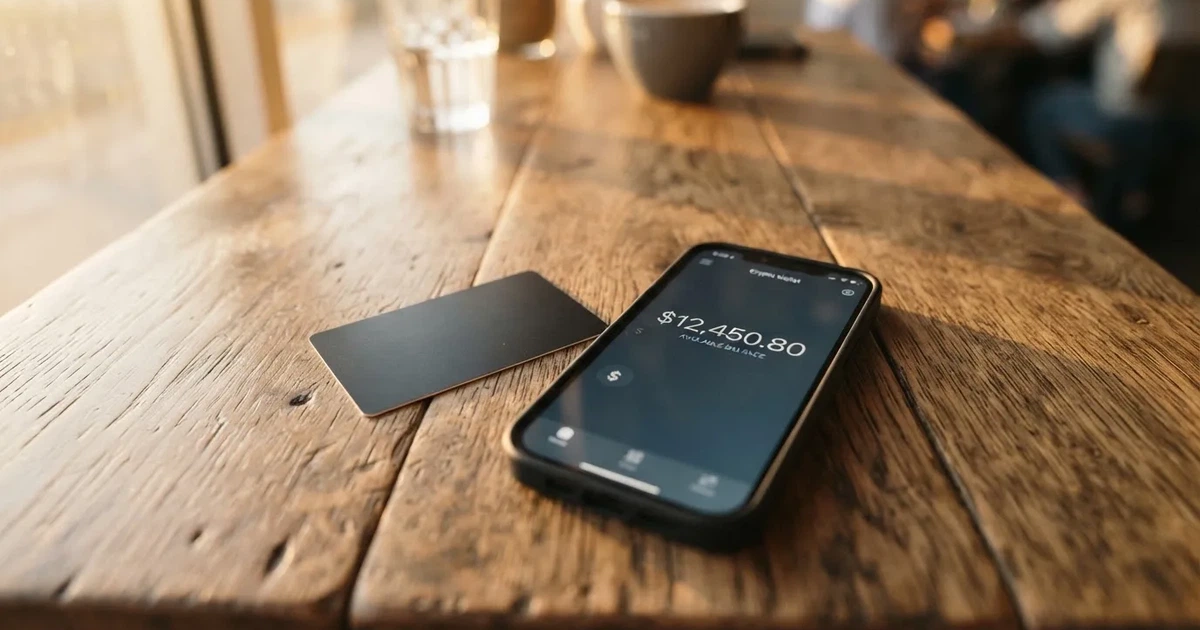
The short version: the pieces are all here, and several of them are genuinely good, but the joining seams show. Cost is a real strength — a virtual card for EUR 2.99, no monthly card fee, free incoming crypto. Top-up breadth is strong too. What pulls the score down is everything around the edges: the issuing partner is not named on the pages I read, ATM behaviour is unclear, Apple Pay is not available for the Mastercard, the physical card story is contradictory, and the biggest single mark against it comes from user reviews rather than from the fee sheet. At 5.6 out of 10 this is a card I would describe as promising and unfinished rather than bad.
The conditions described here are current as of October 28, 2026.
| Criterion | Mark | Why |
|---|---|---|
| Who can get it | 5 / 10 | The card page is labelled “EEA only”, the app has been extended to Montenegro and Andorra, and availability depends on jurisdiction; unofficial sources list 36 countries |
| Cost | 7 / 10 | Virtual card issue EUR 2.99, card servicing free; in-app exchange 0.6% / 0.5% / 0.4% above the free allowance on One / Plus / Pro; unofficial: Plus EUR 9 a month, Pro EUR 18 a month |
| Top-up options | 7 / 10 | Bitcoin, Ethereum and USDC in the app, incoming crypto free on all plans, plus an IBAN; withdrawal networks Ethereum, Tron, Bitcoin, Solana, Polygon, Arbitrum and others |
| Reliability and complaints | 4 / 10 | Issuing partners are not named officially, unofficial: UAB Monavate; Trustpilot 3.2/5 from 78 reviews, with complaints about accounts closed without explanation |
| Everyday use | 5 / 10 | Virtual Mastercard, Apple Pay for Mastercard unavailable while Visa has it, Google Pay works; unofficial: physical orders are not being fulfilled |
| Total | 5.6 / 10 | A solid crypto IBAN with a card attached, held back by support and product gaps |
Who this suits: residents of the EEA who want a euro IBAN and a crypto balance in the same app, and who are comfortable verifying documents in-app and living with a virtual card. Who it does not: anyone who needs a physical card today, anyone who lives in Apple Pay, and anyone for whom an account closure without a clear explanation would be a serious problem — because that is exactly what reviewers report.
Will they give you the card
The card page carries the label “EEA only”. The app has since been extended to Montenegro and Andorra, with availability that “may vary by jurisdiction”. So the rule is not one clean line but two: residence in the covered area, and a nationality carve-out. Brighty states plainly: “Due to regulatory restrictions, we are unable to onboard Russian nationals residing in Montenegro and Andorra.” That is a nationality restriction applied to residents of those two countries, which tells you something about how the company reads risk.
I could not find a full country list on the pages available to me. Third-party sites, not confirmed by the card, put the figure at 36 countries including the EU, EEA, Switzerland, Montenegro, Andorra, San Marino, Monaco and Moldova. Treat that as a rough map, not a promise — the only reliable answer for your country is to open the app and see.
Why this section sits early: eligibility decides everything that follows. If you fall outside the area, or inside it but inside the Russian-nationality exclusion, nothing about fees or plans matters. And note what “may vary by jurisdiction” hides in practice — the ability to complete verification, not merely to download the app.
How to get it
Verification runs in the app at sign-up, and a help article names Sumsub as the provider doing it. The levels of verification are not defined in what I could read, and neither is processing time — both are marked as not stated by the card’s public pages. If something goes wrong, the documented fallback is email to [email protected].
What is spelled out is the document list, which is unusually specific and worth reading before you photograph anything:
- Proof of identity: a clear photo, full name, date of birth, place of birth, citizenship
- Proof of address: a utility bill or bank statement as a PDF no older than three months — screenshots are rejected — or an official registration confirmation, or a second official ID showing your address
- Stated rejection reasons: ambiguous, unclear, contradictory or incomplete documents; an address that does not match the address you signed up with; old or damaged documents; blank fields including the signature
That last list is the one to take seriously. If your utility bill is four months old, or if you are a tenant without a bill in your name, the obvious application can be turned down on a technicality rather than a substance.
On the card itself: the card page shows a virtual card, payable wherever Visa is accepted. The help centre also refers to a physical Visa and to a virtual Mastercard with no PIN. Card currency is not stated. Delivery details — which countries, how long, at what cost — are not stated either, although the card issuance article says a Virtual Card or a Physical Card can be chosen in the app. Unofficial sources, not confirmed by the card, say the Mastercard is issued by UAB Monavate, and that physical card orders are currently unavailable and “will not be fulfilled” according to the help centre.
That last point is the practical crux of the sign-up decision. If you need plastic, do not assume the option in the app means a card is coming. Third-party listings also describe the balances as spanning EUR, USD, GBP, AED and several crypto assets including USDC, EURC, BTC, ETH, ADA, XTZ, TON and SOL — again unofficial, and useful mainly as a hint about which network and asset to pick in the app.
Fees: what it really costs
This is the part of the card that looks best on paper. A virtual card costs EUR 2.99 to issue on every plan, the monthly card service fee is free, a balance inquiry is free, and you can issue up to ten cards a month. The card is a virtual Mastercard. What you pay depends almost entirely on what you do with the money rather than on holding it.
| Item | What it is | Value |
|---|---|---|
| Virtual card issue | One-off, all plans | EUR 2.99 |
| Monthly card servicing | Recurring | Free |
| Balance inquiry | In-app | Free |
| In-app exchange above the free allowance | One / Plus / Pro | 0.6% / 0.5% / 0.4% |
| Free FX allowance per month | One / Plus / Pro | EUR 0 / 2,000 / 5,000 |
| Incoming crypto | All plans | Free, unlimited per month |
| Incoming SEPA | Fiat top-up | 0.3%, minimum EUR 10 |
| Incoming Faster Payments | Fiat top-up | 0.3%, minimum EUR 10 |
| Incoming SWIFT | Fiat top-up | 0.7%, minimum EUR 50 |
| Incoming fiat limit | Per month | EUR 100,000 |
| SEPA / Faster Payments out | One | EUR 3 + 0.3%, minimum EUR 10 |
| SEPA / Faster Payments out | Plus / Pro | EUR 0.5 + 0.3% |
| SWIFT out | All plans | 0.9%, minimum EUR 50 (Pro minimum EUR 30) |
| Outgoing crypto, ERC20 / TRC20 / ARB / TON / Solana / Polygon / BEP20 | Per transfer | EUR 3 |
| Outgoing crypto, BTC | Per transfer | EUR 20 |
| Outgoing crypto, ADA / XTZ / HAQQ | Per transfer | EUR 1 |
| Card purchase limit, daily and monthly | One / Plus / Pro | EUR 50,000 / 75,000 / 100,000 |
| Outgoing fiat, daily and monthly | One / Plus / Pro | EUR 30,000 / 250,000 / 500,000 |
| Fiat account maximum balance | One / Plus / Pro | EUR 100,000 / 250,000 / 500,000 |
What is not stated anywhere in the card’s public material that I could read, and what you should therefore ask before you rely on it: the general cost figure, the exchange rate behind “crypto converts instantly”, the fee for paying in a foreign currency, the ATM fee and allowance, the daily and monthly limits as a single number independent of the plan tiers, the subscription prices for the plans, and the price of a physical card. Those gaps are not automatically bad news — but you are being asked to budget without them.
Now three everyday situations, because that is where fees either matter or do not.
Paying for something priced in euros, from a euro balance. If your IBAN holds euros and you pay an euro-priced shop, the cleanest path is no conversion at all. Nothing to watch here beyond the EUR 2.99 already paid.
Paying a euro-priced subscription from USDC. This is the everyday crypto case. Your crypto is converted into fiat inside the app, and that conversion is where the percentage sits — 0.6% on One, with no free allowance; 0.5% on Plus above EUR 2,000 a month; 0.4% on Pro above EUR 5,000 a month. On a EUR 30 monthly subscription, One costs you about EUR 0.18 in conversion. Trivial. On EUR 5,000 of spending, One costs EUR 30 and Pro costs EUR 20 — which is roughly what the plan pricing is for.
Paying a shop in dollars or pounds from a euro balance. Here the card’s own pages go quiet: the fee for paying in a foreign currency is not stated. That is the single most important number to confirm before you travel, and I would not take it on trust from the app’s marketing line about instant conversion.
One more caution about the exchange mechanism generally. On-chain network fees — gas, or Tron bandwidth — are charged by the blockchain for your deposit, not by the card provider. A crypto top-up therefore has two cost layers, one of which the fee table above does not contain.
How to Top it up
This is where Brighty is genuinely generous, and it is the strongest single dimension of the card alongside cost.
Incoming crypto is free on all plans and unlimited per month. No percentage, no monthly cap, no minimum stated. You can hold Bitcoin, Ethereum and USDC in the app, and what you pay is only the blockchain’s own network fee for sending it. The card page features the NPC token, so there is presumably a reason to hold some of that too, though the rewards rate and payout are not stated.
Alongside the crypto wallet sits a euro IBAN. Incoming SEPA costs 0.3% with a EUR 10 minimum, Faster Payments the same, and SWIFT 0.7% with a EUR 50 minimum, with a monthly incoming fiat limit of EUR 100,000. The card top-up fee and the minimum top-up amount are not stated.
Withdrawal networks listed for outgoing crypto are Ethereum, Tron, Bitcoin, Cardano, Tezos, Islamic Coin, TON, Arbitrum, Solana, Polygon and BEP20. Outgoing fees are the same on all plans with no monthly limit: EUR 3 for ERC20, TRC20, ARB, TON, Solana, Polygon and BEP20; EUR 20 for BTC; EUR 1 for ADA, XTZ and HAQQ.
Two practical warnings belong here rather than in the risks section, because they are mechanics rather than failings. First, sending on the wrong network is a well-known way to lose money in this category: a transfer to a network the provider does not support, or to an address belonging to another network, can be lost or need manual support recovery with no guarantee — blockchain transfers are simply irreversible. Second, if you close your own account, it is “scheduled for permanent deletion within 30 days”; what happens to any remaining balance is not stated, so make sure the balance is empty or withdrawn before you trigger that.
Paying with it every day
In physical terms this is a virtual card, and that shapes everything. It lives in your phone wallet or in the app, it cannot be handed to someone else, and it disappears with the app. The help centre describes a virtual Visa without a PIN, and the fees article describes the card as a virtual Mastercard.
Mobile wallets are where the gap shows. The card page for Montenegro and Andorra mentions Apple Pay and Google Pay; the help article on both, dated 26 May 2026, says Apple Pay is currently unavailable for Mastercard cards because of technical updates, while remaining available for Visa, and that Google Pay works for Mastercard. That means if your Brighty card is the Mastercard — which the fees article says it is — you have Google Pay and not Apple Pay. On an iPhone, that is the difference between tapping to pay and not.
Where the card is accepted is broad: Visa wherever accepted for the virtual card, and ATM acceptance worldwide claimed on the card page. There is a condition attached to ATM use — a physical Visa must be used at an ATM with a new PIN after a PIN change in order to activate — which is a hint that ATM work may depend on a physical card you may not currently have. Unofficial third-party sources report no dependable current ATM feature for the Mastercard, with legacy Visa rates of EUR 3.50 in the EEA and EUR 3.50 plus 3.5% outside on Plus, and EUR 3 in the EEA and EUR 3 plus 3% outside on Pro.
The card page says “Keep earning on your crypto while using it” and does not give a rate or a payout, nor does it describe cashback. Unofficial sources describe 0.5% base cashback in USDC on all tiers, 1.25% to 1.75% in selected categories, and monthly caps of 20 / 60 / 100 USDC on One / Plus / Pro, paid the following month to a Reward Box. Do not plan a budget around that without checking it yourself.
The app itself is listed in the App Store as “Brighty: Crypto Card & IBAN”, with 4.9 from 9 ratings on the Turkish storefront — a small sample, and a regional one. A Google Play rating was not found. And the practical case for crypto cards generally is worth stating plainly here: prepaid and foreign-issued card numbers get declined more often than people expect, because a merchant can look up the issuing institution and country from the first digits of the card number, and some shops apply extra scrutiny when the issuer country differs from the billing address. A declined payment leaves a hold on funds that can last several days.
What can go wrong
I want to be even-handed here, because most of what follows is either ordinary category risk or a genuine unanswered question rather than proof of wrongdoing.
Start with the reviews, since that is where the lowest score comes from. Trustpilot shows 3.2 out of 5 from 78 reviews. The recurring themes: accounts closed without explanation, referral bonuses not paid, and instant transfers taking hours. The company’s stated position on closures is regulatory or policy-driven, and on unpaid referrals it cites suspected referral abuse. Some reviewers praise the cashback. I found no card-specific complaints on Reddit. This is a small sample of self-selected reviewers, not a survey — but 78 reviews at 3.2 is not a rounding error, and “closed without explanation” is the specific complaint that should give a careful person pause.
Next, who actually holds your money. Brighty describes itself as “a financial technology company, not a bank”. Accounts, cards, custody and the on/off ramp all run through licensed partners who are not named on the pages I read, with no licence numbers shown. Press coverage from 2024, unofficial and not confirmed on official pages, describes Brighty as based in Switzerland and holding crypto-exchange and digital-asset custodian licences. In this category the distinction matters: a crypto card often sits on two licences at once, one for the payment card side and one for the crypto side, and if you cannot see who they are, you are trusting a front end rather than an institution.
Custody is custodial. The official FAQ says: “Brighty keeps user funds in segregated accounts that are specially secured”, for both fiat and crypto. Segregated is the right word and means customer money is held apart from company money; it does not mean it is a bank deposit. No insurance is mentioned and two-factor authentication was not mentioned on the page I read. Broadly, this is how the category works: custodial platforms have a real history of failure, and users are accepting counterparty and hack risk in exchange for convenience.
Then the operational controls, which cut both ways. The app lets you freeze the card temporarily and terminate it irreversibly — useful when a card is stolen. But the help centre also lists official offboarding reasons: suspected fraud, unclear source of funds, partner-provider concerns, and PEP or sanctions status. That list is a reasonable set of compliance grounds and it also means account closure is a designed feature, not a malfunction.
What you cannot yet find: a dispute or chargeback process. The help centre has articles on refunds for unsupported crypto deposits and on wrong networks and unsupported cryptocurrencies — both about deposits, not purchases. No card dispute or chargeback article was found. Unofficial sources likewise describe no dispute process. This is a real gap, and it is worth understanding what it means: a chargeback is the mechanism by which an issuer refunds you for fraud, duplicate billing or goods not received, and coverage for prepaid cards varies by jurisdiction and should not be assumed. If you are used to disputing card payments, this is not the card to learn that on.
Two smaller items. There is no published answer on what happens to a balance when you close your own account. And Brighty raised USD 10M in December 2024 per a tech news outlet — context on the company’s stage, not a quality signal either way.
What to take instead
Three alternatives came through the same review process, and the comparison is genuinely close. All three figures below are their own scores out of 10, on the same basis as Brighty’s.
| Card | Score | Who it suits | Watch out for |
|---|---|---|---|
| Brighty | 5.6 / 10 | EEA residents wanting a crypto IBAN and a virtual card | Apple Pay on Mastercard, physical card, disputes, unnamed issuing partner |
| RedotPay | 6.9 / 10 | Users in a long list of countries including India, Indonesia, Turkey | 1.00% transaction fee, USD/HKD card currencies, a much longer KYC exclusion list |
| Wirex | 6.7 / 10 | Users who want both card types and stablecoin spending | Card availability and fees vary by region, “other” fee schedules |
| Bitpanda | 6.5 / 10 | Euro-area residents who want a regulated exchange feel | Euro only, physical Visa only, crypto conversion spread not stated |
RedotPay has the most transparent cost sheet of the three, and the most complicated country story. Its two official lists disagree in a way you should read carefully: the KYC list bars citizens of 36 named countries and territories including Russia, Belarus, Ukraine, Serbia, Montenegro, North Macedonia and the United States, while a card-issuance list dated 28 August 2026 adds India, Indonesia, Morocco, Nepal, Singapore and Turkey for residents only, who are ineligible for both virtual and physical cards and cannot use those addresses for billing. Georgia, Armenia, Kazakhstan and the UAE appear on neither list. Cost: virtual card application 10.00 USD, physical 100.00 USD, virtual replacement 5.00 USD then 10.00 USD, no account maintenance fee, and a Pro tier at 12.90 USD monthly or 129.00 USD annual. Fees are heavier than Brighty’s — a 1.00% transaction fee, 1.20% for non-default currency, 0.2 USD per small authorisation after five free a month, 0.5 USD per decline after three free — plus a list of named merchants carrying 1.5% (min 0.50 USD), including several games and ads platforms. A 5 USD welcome reward cannot be used toward the issuance fee.
Wirex markets itself worldwide in 130+ countries and offers both a virtual card and a physical card that work at POS and ATMs, plus a Visa Signature metal card whose order fee is 45 GBP on the UK page with free DHL Express and 45 EUR elsewhere. Card issuance is free in the UK, EEA, APAC, Singapore, Australia and “Other”, and the card page says no annual or foreign exchange fees — marketing text, with fees that are “subject to change” and exchange rates shown only in the app. Spending can draw on “cash, stablecoins, and cryptocurrencies”, with cryptoback in WXT at 0.5% standard, 3% premium and up to 8% elite, excluding ATM withdrawals, cash advances, crypto purchases, gambling and refunds.
Bitpanda is the plainest option and the least crypto-native in spirit: a physical Visa debit card in euros only, one active card at a time, from a verified account in a euro-area country, with users verified through “Bankident” excluded. Account opening, monthly cost and first shipment are free; reissue is EUR 5.90, or EUR 9.90 for a lost or stolen card, and EUR 10 for each additional physical card. Spending draws from a chosen main asset — cryptocurrencies, precious metals or EUR — converted at payment with a minimum of EUR 1, Crypto Indices excluded. The FX fee is listed as EUR 0 but “VISA mark-up fees apply”, and the crypto conversion spread is not stated. Cashback is stated as 1% on crypto spending in the body text and “up to 2%” in the summary, which is unreconciled on the page itself.
My read: if Apple Pay on an iPhone is non-negotiable, none of these solves it today for a Mastercard-based crypto card — Wirex is the one worth checking region by region. If you want the cheapest virtual card and the free crypto top-up, Brighty wins. If you want the clearest published numbers before you commit, RedotPay wins at the cost of a higher per-transaction percentage.
Who I would recommend it to
I would recommend Brighty to three specific people.
The first is an EEA resident who already holds crypto, mostly in stablecoins, and whose priority is a euro IBAN plus a card in the same app with free incoming transfers. That is the card at its best: free crypto in, EUR 2.99 for the card, no monthly fee, 0.6% exchange on the free plan or less if you pay for a higher one.
The second is someone comfortable with virtual-only and Google Pay rather than Apple Pay, who does not plan to argue a disputed purchase through a chargeback process, and who treats an app-based card as a convenience rather than a primary account.
The third is someone who will genuinely check the numbers themselves before they load money — who will look up their country’s eligibility in the app, read the free FX allowance against their plan, and confirm the foreign-currency fee that the card’s pages do not state.
I would steer away from it if you need a physical card now, if you are on iPhone and count Apple Pay as essential, if you are buying things you might need to dispute, or if an unexplained account closure would leave you unable to act. The Trustpilot pattern on closures is the reason for that caution, and it is why this review lands at 5.6 rather than higher. The same applies if you are comparing this with a regulated exchange in your own country: the difference between an e-money or payment institution and a “financial technology company, not a bank” is not a technicality.
Frequently asked questions
What is the Brighty card?
Brighty is a payment card issued through a fintech app that also holds crypto and provides a euro IBAN. You load funds from crypto or a bank transfer and spend them like ordinary card money. The card page presents it as a virtual card payable wherever Visa is accepted, while help articles also reference a physical Visa and a virtual Mastercard. The card’s own pages describe the company as a fintech, not a bank.
Is Brighty a bank?
No. The card states plainly that Brighty is a financial technology company, not a bank, and that accounts, cards, custody and the crypto on/off ramp run through licensed partners. Those partners are not named on the pages I read and no licence numbers are shown there. Press coverage from 2024 described a Swiss base and crypto licences, but that is unofficial and unconfirmed on official pages.
Who can get a Brighty card?
The card page is labelled “EEA only”, with the app extended to Montenegro and Andorra and availability varying by jurisdiction. Brighty also states it cannot onboard Russian nationals residing in Montenegro and Andorra. A full country list was not found; unofficial sources put it at 36 countries. Eligibility is decided by where you live and, in those two countries, your nationality.
Does the Brighty card require KYC?
Verification runs in the app at sign-up. You need a clear identity photo with your full name, date of birth, place of birth and citizenship, plus proof of address: a utility bill or bank statement PDF under three months old, an official registration confirmation, or a second ID showing your address. Screenshots are rejected. Mismatched addresses, damaged or old documents and blank fields are stated rejection reasons.
How much does the Brighty card cost?
A virtual card costs EUR 2.99 to issue on every plan, the monthly card servicing fee is free, and balance inquiries are free. In-app currency exchange above your free monthly allowance costs 0.6% on One, 0.5% on Plus and 0.4% on Pro. Plan prices are not stated officially; unofficial sources say Plus is EUR 9 a month and Pro EUR 18 a month.
How do I top up the Brighty card?
Incoming crypto is free on all plans with no monthly limit, and network fees are charged by the blockchain rather than by Brighty. You can also fund the IBAN: incoming SEPA and Faster Payments cost 0.3% with a EUR 10 minimum, SWIFT 0.7% with a EUR 50 minimum, and incoming fiat is capped at EUR 100,000 a month. Card top-up fees and minimum amounts are not stated.
Can I add Brighty to Apple Wallet?
Not reliably, and this is the card’s most practical weakness. A help article dated 26 May 2026 says Apple Pay is currently unavailable for Mastercard cards because of technical updates, while remaining available for Visa. Google Pay does work with Mastercard. Since the fees article describes the card as a virtual Mastercard, iPhone users should assume Google Pay only, and confirm in the app before relying on it.
Is the Brighty card safe?
Treat it as custodial. Brighty says user funds are kept in segregated accounts that are specially secured, for both fiat and crypto, and the app offers instant card freeze and permanent termination. No insurance is mentioned and two-factor authentication was not mentioned on the page I read. Because custody sits with the company and its unnamed partners, you are accepting counterparty risk the same way you would with any exchange.
What happens if I have a problem with a payment?
That is the largest unanswered question here. I found no card dispute or chargeback article in the help centre — only articles about refunds for unsupported crypto deposits and about wrong networks. If a purchase goes wrong, the documented path is email to [email protected]; no phone number, live chat or opening hours are listed. Do not assume prepaid-card reversal rights apply to a Brighty purchase.
Should I close my Brighty account?
Know what happens to the balance first. A user-initiated closure schedules the account for permanent deletion within 30 days, and the card does not state what happens to any remaining balance. Withdraw or spend it before you close. Separately, official offboarding reasons include suspected fraud, unclear source of funds, partner-provider concerns and PEP or sanctions status.
App and neobank cards – cryptocardsearch.com
Content created by the «cryptocardsearch.com» team