
Trastra card: a euro-denominated Visa prepaid card spent from a crypto balance, built for EEA residents
 Available in US
Trastra is a Visa prepaid debit card that draws on a euro balance you top up from cryptocurrency held in the Mover wallet. The programme is operated by the e-money institution UAB “Finansinės paslaugos ”Contis“” under a Bank of Lithuania EMI licence, and the front-end is built around the Mover app, which manages both the crypto wallet and the card account. If you live in the European Economic Area and want a card that spends the euro equivalent of your crypto, Trastra is designed to fit that use case. If you live outside the EEA, or if you want a tier system, a cashback programme or a virtual card, the picture thins out quickly.
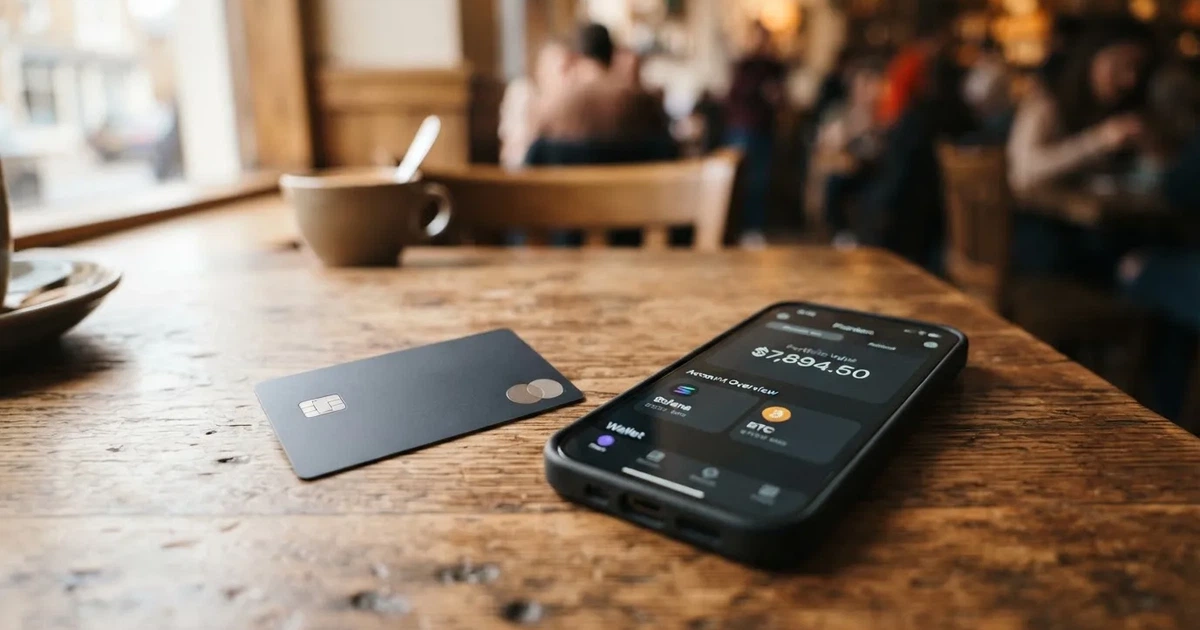
This review walks through who can actually get the card, what it costs in practice, how the top-up flow works, and the complaints that real users have raised on Trustpilot. The conditions described here are current as of October 28, 2026.
Verdict: 4.1 / 10 — Niche but Limited
The Trastra card lands at 4.1 / 10 in my assessment. It is a straightforward euro prepaid card for a specific audience — EEA residents who want to convert crypto into a euro balance and spend it at Visa merchants — but it has narrow availability, a single tier, no stated cashback, and a Trustpilot score that is hard to ignore. If you fall inside the intended audience and your spending is modest, it does the job. If you want a broader feature set, more flexibility on where you live, or a programme with a longer track record of clean reviews, you will probably want to look elsewhere.
The breakdown is:
| Criterion | Score | Why it scores here |
|---|---|---|
| Who can get it | 5 / 10 | Available in 31 listed countries, including Germany, France, the UK; EEA-wide roll-out promised; non-European residents cannot apply yet |
| Cost | 3 / 10 | EUR 9.00 card order fee, EUR 15.00 annual management fee, 3% on non-EUR payments, EUR 2.25 per euro ATM withdrawal |
| Top-up options | 4 / 10 | Crypto top-up inside the Mover wallet, crypto-to-EUR exchange is free, but supported coins and networks are not publicly listed |
| Reliability and complaints | 3 / 10 | Contis EMI licence from the Bank of Lithuania; Trustpilot 2.0 out of 5 across 747 reviews, with frozen funds and denied withdrawals recurring |
| Everyday use | 6 / 10 | Accepted at Visa merchants and ATMs across Europe, dedicated EUR IBAN; unofficial mentions of Apple Pay and Google Pay; no virtual card listed |
| Total | 4.1 / 10 |
The card makes most sense for an EEA resident who already has crypto sitting in a Mover wallet and wants a euro card that picks it up at the point of sale, without converting to a bank account first. If that is not you, the cost stack and the complaint profile make the alternatives worth a serious look.
Who Will They Give You the Card?
Trastra lists 31 countries where the card is available, including Germany, France and the United Kingdom. The card page also says it “will be available for all residents of the European Economic Area (EEA)”, which reads as a roll-out promise rather than a current fact: the card-eligibility list is the one that determines who can actually order today. The rules appear to be based on residence, not citizenship, but if you are a non-European resident, the page is direct: “Not at the moment.”
That last line matters. If you live outside the EEA, you cannot apply for this card through the official channel, regardless of which passport you hold. The programme is structured around the European e-money licence held by the issuer, and the eligibility list mirrors the geographic scope of that licence.
A few practical points that follow from the eligibility setup:
- EEA residents in unlisted countries may be able to apply under the EEA-wide promise, but the public country list is the safer reference until a specific country is removed from the “coming soon” set.
- UK residents are on the list, so the card is available post-Brexit, even though UK fintechs often face extra friction with EU-licensed issuers.
- US residents are not eligible. Neither are residents of most non-European jurisdictions.
Age, document and address-proof requirements are not stated on the public card page. The card is described as a “prepaid debit card” accepted at Visa merchants worldwide, and the ATM use that the card supports implies a physical card, although the public page does not explicitly separate a virtual card from a physical one.
How to Get It
The application flow runs through the Mover app or the Mover web app, not through a standalone Trastra site. Mover is the wallet and account layer; Trastra is the card programme on top of it. The security features built around the account are visible on the page: Visa Identity Check, 3-D Secure on online payments, two-factor authentication with one-time codes, and device authorisation by email for new devices or browsers.
The card-order fee is EUR 9.00 and is charged from your first top-up. The annual EUR 15.00 management fee is also deducted from the card balance, with the first charge within 45 days of ordering. Card delivery is free to the 31 listed EEA countries, but the delivery time and any replacement-card cost are not stated on the page.
What the public page does not spell out about the sign-up:
- Identity documents required — not stated (only the security layer around the account is described).
- Address proof — not stated.
- Age requirement — not stated, though prepaid and debit cards in the EU are generally available to adults.
- Verification timing — not stated; only the post-login security is described.
- Card activation steps — not stated separately from the order flow.
For the ordinary EEA user, the practical effect is that the sign-up is mobile-first and the account is gated by the Mover app’s verification, but the public documentation stops short of promising specific turnaround times or a fixed document set.
What It Really Costs: Fees
Trastra’s fee stack is a mix of fixed charges and a percentage that only kicks in when you spend or withdraw in a currency other than euros. The headline numbers from the fee schedule are:

| Fee or limit | Amount |
|---|---|
| Payment account creation | Free |
| Card order | EUR 9.00 (charged from first top-up) |
| Card delivery | Free |
| Card management | EUR 15.00 per year (first charge within 45 days of ordering) |
| Non-EUR card purchase (online or offline) | 3% |
| Internal card-to-card transfer | EUR 0.20 |
| Crypto-to-EUR exchange | Free |
| Balance inquiry at ATM | EUR 0.35 |
| PIN change at ATM | EUR 0.40 |
| Euro ATM withdrawal | EUR 2.25 |
| Non-euro or outside-EEA ATM withdrawal | EUR 2.25 plus 3% |
| Max card balance | EUR 8,000 |
| Daily card spend | EUR 7,700 |
| Daily ATM withdrawal | EUR 3,00 (EUR 300) |
| Overall daily spend (purchases + ATM) | EUR 8,000 |
| Weekly, monthly or annual limits | None stated |
A few everyday situations make the stack more concrete. None of these are exact comparisons, just shapes:
- Buying lunch in Berlin with the euro balance. No conversion fee, no FX, just the EUR 15.00 annual management fee amortised over the year. The cheapest way to use the card.
- Booking a hotel in London in pounds. The 3% non-EUR fee applies on top of whatever the Visa exchange rate is. That is the part of the stack that hurts if you travel outside the eurozone.
- Withdrawing EUR 200 from a eurozone ATM. The EUR 2.25 fee is fixed, so a single big withdrawal is cheaper per euro than several small ones. Some ATM operators add their own surcharge on top, which is outside Trastra’s control.
- Withdrawing the equivalent of EUR 200 in Swiss francs at a non-EEA ATM. The EUR 2.25 plus 3% fee applies.
The fees that are not listed are worth noting too: top-up minimums, fiat top-up options, replacement-card costs, and the cost of moving a balance back into crypto. None of these are stated on the public page.
How to Top It Up
Top-up happens inside the Mover wallet, and the flow is the part of the product that the card page describes the least precisely. The page says the card is “topped up using cryptocurrencies in your Mover wallet” and that crypto-to-EUR exchange is “Free” with the rate set at the moment of the transaction. Beyond that, the supported coins, supported networks and minimum top-up amounts are not stated on the public card page.
That gap matters more than it sounds. Crypto top-ups depend on the network you send on, and a transfer on the wrong network can be lost or need manual recovery with no guarantee. A reader who holds USDT on Tron, for example, cannot tell from the card page whether that asset and network are accepted, or whether they need to bridge to a different chain first. The same goes for stablecoins on Ethereum, Solana, Base or any of the other networks where USDC and USDT are issued.
What is stated:
- Source of funds — crypto in the Mover wallet.
- Exchange to EUR — free, rate fixed at the time of the transaction.
- Where the card-order fee comes from — your first top-up (can be offset by Mover’s Smart Treasury bonuses).
- Fiat top-up options — not stated.
- Minimum top-up — not stated.
- Supported coins and networks — not stated.
For the actual list of supported assets and chains, the Mover app or its support channels are the only sources. That makes the top-up step the one part of the flow where the public documentation is most likely to leave a new user with a question they cannot answer from the website.
Paying With It Every Day
The card is accepted at Visa merchants worldwide, and the Mover apps for Android and iOS are the management layer. There is also a web app at app.viamover.com. The card has a dedicated personal EUR IBAN, which means you can receive SEPA payments into the card account and treat it as a light current account on top of the prepaid card.
Two everyday-use notes that the public page does not cover in detail:
- Mobile wallets — The card page does not mention Apple Pay or Google Pay. Trastra’s own self-description on its Trustpilot company page refers to Google Pay and Apple Pay support, so this is unofficial and not confirmed by the card’s published materials. Treat it as a possibility, not a guarantee.
- Virtual card — The page does not describe a virtual card product. ATM use implies a physical card, and there is no mention of a virtual-only option for online subscriptions or one-time online purchases.
- Cashback or rewards — The page describes no cashback or points programme. Internal card-to-card transfers are EUR 0.20 each, and there is no mention of any spending rebate.
The practical daily-use profile is closer to a euro prepaid card than to a modern metal or credit-style crypto card. If your week is buying groceries in euros, paying a streaming subscription, and occasionally pulling cash from an ATM, the card handles that. If your week includes subscriptions in dollars, frequent foreign travel, or a desire for a tokenised mobile wallet and a virtual card, the feature set is thinner than the alternatives.
What Can Go Wrong
The risk picture is dominated by the complaints profile on Trustpilot and by what the issuer and the licence do and do not cover.
Regulatory standing. The card is issued by UAB “Finansinės paslaugos ”Contis“”, which holds an electronic money institution licence (No. 53) from the Bank of Lithuania. As an EMI product, the funds are held in a segregated account and “not covered by the Deposit Insurance System of the Republic of Lithuania”. That is the standard trade-off: EMI segregation is not the same as deposit insurance, and a failure of the issuer is not the same as a bank failure.
Complaints profile. Trastra’s Trustpilot score is 2.0 out of 5 across 747 reviews (read on 2026-10-20). The distribution is unusual: 65% of reviews are five-star, but 23% are one-star, which produces a bimodal pattern — readers who had no problem, and readers who had a serious one. Recurring themes in the negative reviews from January to December 2025 include:
- Blocked or frozen funds, sometimes for extended periods.
- Withdrawals denied, including to local bank accounts.
- Support responding with copy-paste replies and not resolving the underlying issue.
- A maintenance window during which balances were inaccessible (March to June 2025).
- Worries about insolvency or closure of a related entity, including a March 2025 email reportedly referencing “Initiation of Insolvency Proceedings” and May 2025 claims that the company is closing, with users citing police information about bankruptcy proceedings.
These reviews concern the Trastra service, and not necessarily the Mover card product, but they describe the same company and the same support layer. The number of new reviews is small — only seven in the last twelve months — so the score is slow-moving and reflects an older wave of complaints as much as the current state of the service.
Programme closure risk. A card programme that depends on a Visa-licensed issuer can be wound down if the issuer, the network or the programme manager runs into trouble. Visa’s November 2022 termination of its global agreements with FTX, and the earlier 2018 suspension of WaveCrest in Europe, are the reference cases. Neither is a direct precedent for Trastra, but both illustrate that “your card works today” is not the same as “your card will work next year”.
Security safeguards. On the side the card does handle, the security stack is solid: every transaction verified by Visa and 3-D Secure, login by wallet password plus 2FA, new device approval by email, and segregated funds at the EMI. An in-app card-freeze button is not described on the public page, and the dispute process is not stated.
Support. Support is by email at [email protected], with a knowledge centre at faq.viamover.com. Languages and hours are not stated, which is one of the practical frustrations that shows up in the negative Trustpilot reviews.
What to Take Instead
Three alternatives that are easier to compare against Trastra on the same axes:
| Card | Score | Card type | Annual fee | FX fee | Funding model | Cashback |
|---|---|---|---|---|---|---|
| Trastra | 4.1 / 10 | Visa prepaid debit, EUR | EUR 15.00 | 3% non-EUR | Crypto in Mover wallet | None stated |
| Gemini Credit Card | 4.9 / 10 | Mastercard World Elite credit | None | None | Paid off in fiat | 1–4% in crypto, 10% Vault Rewards at some merchants |
| Lava Card | 7.1 / 10 | Network not stated | None | None, no FX spread | Local currency or stablecoins | Up to 5% back in bitcoin |
| RedotPay | 6.9 / 10 | Visa debit, USD or HKD | None on standard tier | 1.00% conversion, 1.20% non-default | Crypto deposit or credit-card buy in app | 5 USD welcome reward; no card cashback rate stated |
Gemini Credit Card. A Mastercard World Elite credit card with no annual fee and no foreign transaction fees, paid off in fiat. The draw is the rewards: 4% on gas, EV charging and transit (capped on the first $300 per month), 3% on dining, 2% on groceries, 1% elsewhere, paid instantly in Bitcoin or 50+ cryptos. A referral programme adds a $50 crypto bonus per sign-up, up to 50 per year. The trade-off is that this is a credit card, so it depends on a credit assessment in the US, and the availability of supported coins and networks is irrelevant because the card is not funded from a crypto balance.
Lava Card. A card accepted at 150 million merchants in 150+ countries, with no annual fees, no FX fees and no FX spread, and up to 5% back in bitcoin on every purchase. The funding model is local currency or stablecoin deposits, and the precise networks and conditions are not fully described on the public page. The cost profile is the strongest of the four on the published numbers.
RedotPay. A Visa debit card issued in USD or HKD, with virtual and physical versions. The cost stack is heavier on the application fee side: USD 10.00 for a virtual card, USD 100.00 for a physical card, with a RedotPay Pro tier at USD 12.90 per month or USD 129.00 per year. Transaction fees are 1.00% for the crypto conversion, 1.20% on non-default currencies, and certain merchants carry 1.5%. Funding is on-chain crypto deposit or in-app credit-card buys of ETH, USDC and USDT. Availability is broader than Trastra in some regions and narrower in others; a long list of unsupported countries, including the US, gates KYC.
If you are an EEA resident who only needs a euro prepaid card, Trastra is in the running. If you want lower FX, no annual fee, a stated cashback rate, or broader country coverage, the alternatives above are worth comparing on the same axes.
Who I Would Recommend It To
The audience that fits the Trastra profile is narrow but real:
- EEA residents already using the Mover wallet. If you hold crypto in Mover and want a euro Visa that picks it up directly, the conversion is free and the flow is the same app. The EUR 15.00 annual fee and EUR 9.00 card-order fee are the fixed cost of that convenience.
- Modest spenders, mostly in euros. With a max card balance of EUR 8,000 and a daily spend cap of EUR 7,700, the card is built for normal everyday spending, not for high-volume use. If your monthly card spend is below a few thousand euros, the 3% non-EUR penalty only bites when you travel.
- Users who can tolerate a thinner feature set. No stated cashback, no described virtual card, no described card-freeze button, and no stated support hours. If those gaps are deal-breakers, the alternatives are stronger.
The audience that should look elsewhere:
- Non-EEA residents. The card is not available to you through the official channel today.
- Frequent travellers outside the eurozone. A 3% FX penalty on every non-EUR payment is a high baseline, even with a free crypto-to-EUR exchange.
- Users who need a credit-style rewards card. Trastra is prepaid, so there is no cashback, no credit line and no rewards programme.
- Readers who are sensitive to the complaints profile. The Trustpilot pattern is real, even if it reflects an older wave, and the small number of recent reviews means the score moves slowly.
Frequently Asked Questions
What is the Trastra card?
The Trastra card is a Visa prepaid debit card that draws on a euro balance you top up from cryptocurrency held in the Mover wallet. It is issued by UAB “Finansinės paslaugos ”Contis“” under a Bank of Lithuania e-money institution licence, and managed through the Mover mobile and web apps.
How does the Trastra card work?
You hold crypto in your Mover wallet, exchange it to euros at the prevailing rate (free, per the public page), and the euro balance is loaded onto the card. At the till or online, the card behaves like a standard Visa prepaid card. Non-EUR payments trigger a 3% fee on top of the Visa exchange rate.
Is Trastra a bank?
No. Trastra is the card programme; the issuer is UAB “Finansinės paslaugos ”Contis“”, an electronic money institution licensed by the Bank of Lithuania. EMI funds are held in a segregated account and are not covered by the Deposit Insurance System of the Republic of Lithuania, which is a different regime from a bank deposit.
Who owns Trastra?
Mover is described as a partner of Trastra, and Holyheld Labs is described as an authorised partner of Trastra Inc. The card-issuing entity is UAB “Finansinės paslaugos ”Contis“”. The exact ownership chain between Trastra Inc., Holyheld Labs and Mover is not stated on the public card page.
Is the Trastra card available in my country?
It is available in 31 listed countries, including Germany, France and the UK, and the page says it “will be available for all residents of the European Economic Area (EEA)”. For non-European residents, the page states: “Not at the moment.” The 31-country list is the practical reference for who can apply today.
How do I apply for the Trastra card?
Applications run through the Mover app or the Mover web app. The card-order fee of EUR 9.00 is charged from your first top-up, and the annual EUR 15.00 management fee is charged from the card balance, with the first charge within 45 days of ordering. The specific identity documents, address proof and age requirement are not stated on the public page.
Does the Trastra card require KYC?
The public page describes the security layer (Visa Identity Check, 3-D Secure, 2FA, device authorisation) but does not list the KYC documents, address proof or age requirement. As an EMI-issued product under EU rules, customer due diligence applies, but the public documentation does not itemise what you will be asked to provide.
How do I top up the Trastra card?
You top up the card by exchanging crypto held in your Mover wallet to euros inside the app. The exchange is free, and the rate is set at the time of the transaction. The supported coins and networks, the minimum top-up, and any fiat top-up options are not stated on the public card page.
Is the Trastra card safe?
The account is protected by Visa Identity Check, 3-D Secure, two-factor authentication and device authorisation by email, and the funds are held in a segregated account at the EMI. The EMI product is not covered by Lithuanian deposit insurance, and the Trustpilot score of 2.0 out of 5 across 747 reviews, with recurring complaints about frozen funds and denied withdrawals, is a part of the safety picture that the public page does not address.
Is the Trastra card worth it?
It depends on your country, your spending pattern and your tolerance for the complaint profile. For an EEA resident who already uses Mover and spends mostly in euros, the free crypto-to-EUR exchange and the dedicated EUR IBAN are real benefits. For a frequent traveller, a non-EEA resident, or a user who wants a richer feature set, the cost stack and the limited eligibility make the alternatives a stronger fit.
Credit and cashback cards – cryptocardsearch.com
Content created by the «cryptocardsearch.com» team