
PayPilot card: simple euro spending from crypto, if you can get one
 Available in US
The PayPilot card is a Visa payment card that draws on a euro balance you top up with crypto or euros. If you live somewhere the card is actually offered, and you mostly spend in euros, it does the simple job well: no issuance fee, no monthly fee, payments in euros are free, and converting crypto to euros at the moment of spend costs 0.4%. The score, on the criteria I checked, is 7.4 out of 10.
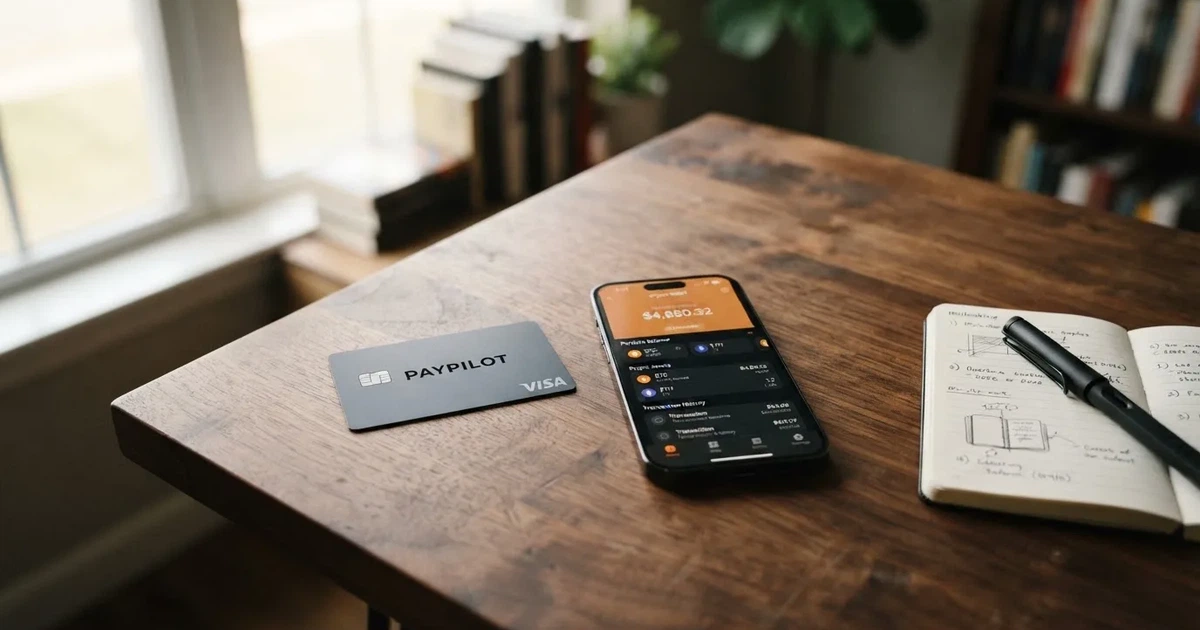
The score drops mainly because the card does not publish a country list, so most readers cannot tell from the website whether they are eligible. The other reason is that the company behind the card is split across three different entities on three different pages, and it takes some digging to find out who actually issues the card and under which licence. None of that makes the card unsafe on its own, but it is the kind of opacity that a careful user should not ignore.
Conditions are current as of October 28, 2026.
Verdict
I would sum up the PayPilot card as a clean euro-spending tool for someone who already holds crypto and wants to convert small amounts to fiat for everyday payments. If that is you, and you are in a supported country, the cost structure is one of the better ones in the category. If you are looking for a rewards-heavy card, a multicurrency card, or a card that works in the United States, this is not it.
Here is the breakdown behind the 7.4.
| Criterion | Mark | Why |
|---|---|---|
| Who can get it | 5/10 | Eligibility depends on country of residence and local rules, and the card does not list supported regions |
| Cost | 9/10 | No issuance or monthly fee, no commission on euro payments, 0.4% to convert crypto to euro; FX fee not disclosed |
| Top-up options | 6/10 | BTC, ETH, USDT and EUR accepted, but the card does not say which networks, and EUR top-up fees are not stated |
| Reliability and complaints | 8/10 | Card is issued by Walletto UAB under Bank of Lithuania electronic-money licence No 33 (29 March 2018); no complaints found |
| Everyday use | 9/10 | Visa card, virtual and physical, plus Apple Pay and Google Pay and ATM cash withdrawal |
| Total | 7.4/10 |
The card suits you if you are an euro-area spender topping up with crypto, in a country where PayPilot operates, and you are comfortable with a card whose fee sheet is short on details. It does not suit you if you need a published list of supported countries, cashback, a US option, or a clear FX mark-up in writing.
Who will actually give you the card
The card’s own eligibility page says availability “depends on your country of residence and local regulations”, and that is as far as it goes. There is no list of supported or unsupported countries, no drop-down, and no way to enter a country on the site to check. The rule is set by where you live, not by your passport, and the company does not say which passports it accepts either.
That gap matters more than it sounds. If you are reading this from a country you suspect might be excluded, you will not find the answer on the public site. You would have to register, attempt the identity check, and find out at that point. That is a poor user experience, and it is also a soft red flag, because in this category cards that are confident about their licence and their regulatory perimeter tend to publish the list.
What the card does say is that you have to pass a one-time identity verification before the card is created. Documents, proof of address, and the minimum age are not stated on the public page. Card terms do reserve the right for the issuer to re-verify your identity and ask for more documents at any time. In practice, expect a government-issued ID, a selfie or short video, and a proof of address such as a utility bill or bank statement, because that is the European standard for an electronic-money institution. KYC partners named on the site are KycAid and Ondato.
How to get it
The process is the same one every regulated card in this category follows, and PayPilot describes it in three steps: register, verify, create card. The card is a Visa that works online and in stores, and it spends from a euro balance. The card page itself does not say whether the first card is virtual, physical or both, but the card terms allow for a virtual card, which is usable immediately, and a physical card that is sent by post and needs to be activated. The site also does not say how long the physical card takes to arrive or how much postage costs in the country pricing page.
In practical terms, the first usable artefact for most people is a virtual Visa number you can add to Apple Pay or Google Pay and use straight away at online checkout. The physical card is the one that needs to be ordered and arrives in the post. Issuance for the card itself is 0 EUR for both, but the issuer’s pricing page for some countries folds postal costs into that figure, so the post you actually receive is not necessarily free of charge in every market. That is one of the details I would expect a more transparent card to publish in plain language.
What it really costs: fees, payments, the everyday cases
The cost story is short, mostly because PayPilot has not published much. Here is what is stated, taken at face value.
| Fee or limit | Amount |
|---|---|
| Card issuance | 0 EUR |
| Monthly service fee | 0 EUR |
| Payment from euro balance | 0 EUR commission |
| Crypto-to-euro conversion | 0.4% |
| FX fee (non-euro merchants) | not stated |
| ATM cash withdrawal fee | not stated |
| ATM cash withdrawal allowance | not stated |
| Single-payment limit | not stated |
| Daily payment limit | not stated |
| Monthly payment limit | not stated |
| Minimum top-up | not stated |
| EUR top-up fee | not stated |
Three everyday cases show how the numbers actually apply.
You are paying for groceries in Berlin, in euros, from a euro balance you topped up earlier. The payment clears with no commission, and you see the full amount on your statement. This is the case PayPilot was built for, and it is genuinely cheap.
You are topping up with USDT and paying the same Berlin grocer a few hours later. The conversion from USDT to EUR runs at 0.4%, the merchant is paid in euros, and you are done. The 0.4% is the only card-side fee you pay. On top of that, you will have paid the network fee for the USDT transfer on the way in, which the card does not charge but the blockchain does.
You are buying something online in US dollars, paid from your euro balance. This is where the missing FX fee matters. The card’s own payment account terms say exchange rates are “based on Visa/Mastercard published rates at the time of exchange”, with the fee level specified in the payment account, but the actual mark-up in basis points is not in the public fee table. Visa’s interbank rate is the reference; the question is how many basis points PayPilot adds on top. The card page does not say, and that is a real gap. If you are a heavy cross-border spender, this is the one figure I would ask the support team to confirm in writing before relying on the card.
The wallet holds BTC, ETH, USDT and EUR. Card terms mention single, daily, weekly and monthly maximum payment amounts set by the issuer, but the values are not on the public page. So there is a ceiling; you just cannot see it before you sign up.
Top up and funding
Funding the card is the one place where I would have liked the card to say more. The FAQ says you can top up with BTC, ETH, USDT or EUR, and the card spends from the euro balance, with crypto converted at 0.4% at the moment of payment or when you convert in advance. That is the full extent of the public information. The networks on which BTC, ETH and USDT are accepted, the minimum top-up amount, the EUR top-up fee, and how long a top-up takes to land are not stated.
If you are used to sending crypto, treat the absence of a network list as a stop signal rather than a nudge. Sending USDT to an Ethereum address when the card only accepts Tron, or vice versa, is the kind of mistake you cannot undo. Most crypto cards in this category publish a per-asset network list, and the absence of one on PayPilot is the single feature I would most want to see added.
EUR funding is, in principle, the cheaper route, because it skips the 0.4% conversion. How the EUR gets in is the part that is not spelled out on the public site: SEPA, card top-up, or both. The fee for an EUR top-up is also not stated. If you have an euro bank account, this is the question to put to support before your first top-up.
There is also an off-ramp. You can sell crypto for EUR inside the wallet and withdraw the EUR to an IBAN, subject to limits and compliance checks. If you close the payment account, the card becomes invalid. What happens to a remaining balance on closure is not stated, and that is another detail worth confirming before you load more than you intend to spend in the near term.
Paying with it every day
Once the card is funded, the everyday experience is plain. The virtual card can be added to Apple Pay or Google Pay, both of which the FAQ confirms. The physical card works in stores that take Visa and at any ATM that takes Visa. The card page does not list blocked merchant categories, so I cannot tell you whether gambling, crypto purchases, or adult merchants are refused. In practice, that usually means blocked by default at the issuer’s discretion, but I would not rely on that for anything sensitive; if a specific category matters to you, ask.
The app is published on the Apple App Store and on Google Play (org.paypilot.app). Store ratings were not available to me at the time of writing, so I cannot tell you whether users are happy with the app. That is worth checking yourself, because in this category the app is the card, in the sense that it is how you check your balance, convert crypto, freeze the card, and reach support.
A specific point on disputes. The card terms say that a payment made with the card credentials is “deemed authorised”, and that a refund is only available if the payee agrees to refund. The formal chargeback procedure, the time frames, and the reason codes that apply are not stated. The card can also be rejected by the issuer if it has been blocked or the account is restricted. Compare that to a bank debit card issued under PSD2 in the EU, where unauthorised payments have to be refunded within set deadlines, and you see the gap. In a category full of opaque dispute terms, PayPilot is at the less transparent end.
What can go wrong
Three categories of risk are worth thinking about, in that order.
The first is regulatory and counterparty. The card is issued by Walletto UAB, a Vilnius-registered electronic money institution (company code 304686884), under Bank of Lithuania licence No 33 dated 29 March 2018. The card terms I read are dated May 2024. The footer of the site splits roles: Pilot Innovation Sp. z o.o. develops the platform, Nexora Fintech Limited provides financial services “where applicable”, and Walletto UAB is the card issuer. If you need to know who to complain to, who holds your money, and under which regulator, the answer is the Lithuanian licence and the Bank of Lithuania. That is a real European passport, but it is not the same as a bank deposit guarantee: e-money funds are safeguarded, not insured, and they are not covered by deposit guarantee schemes.
The second is security. The site claims AES-256 encryption, PCI-DSS, ISO 27001, cold wallet storage, two-factor authentication, and an audit reserve. These are claims, not audit reports you can read. The card terms add that you can ask for the card to be blocked at any time, that a physical card is blocked after three wrong PINs, and that the issuer may block it on suspicion of fraud. The custody model is not described in detail, so you do not know whether funds are held in pooled omnibus wallets, segregated client accounts, or in any of the standard configurations a regulated e-money institution would be expected to use. With a custodial card, that opacity matters more than with a self-custody-linked one, because the issuer is the one holding the funds.
The third is support. You can reach PayPilot by email at [email protected], via a “Write to us” form on the site, or on X, Telegram, Instagram, Facebook and LinkedIn. Hours are not stated, and there is no published service-level agreement. In this category, that is not unusual, but it is also where most user frustrations end up concentrated, so it is worth noting.
In the wider world, this category has had two well-known failures worth keeping in mind. In 2018, Visa suspended WaveCrest, a card issuer used by several crypto card programmes, and every WaveCrest-issued Visa was closed. In November 2022, Visa said it had terminated its global agreements with FTX after the exchange’s collapse, and the FTX US debit card was wound down. Neither of those is PayPilot’s story; both are reminders that a card’s existence is always subject to the network’s and the issuer’s licence. If you keep a balance on the card, keep it small.
What to take instead
A direct comparison is hard, because the category has not settled on a single shape. Three alternatives that are in the same ballpark, with their own trade-offs.
RedotPay, 6.9/10, is a card that has published its restricted-country lists and is more transparent about who can sign up. The two lists do not quite match, which is itself a friction, but at least you can tell. The fee model is heavier: 10 USD for a virtual card, 100 USD for a physical, plus a 1% transaction fee and a 1.20% non-default-currency fee. There is a paid tier, RedotPay Pro, at 12.90 USD per month or 129 USD per year. It suits someone who wants the country list up front and is willing to pay for the privilege.
Bitpanda, 6.5/10, is a euro-area option that converts from a chosen asset at the point of payment, with a 1% cashback on crypto spending, sometimes advertised as “up to 2%”. Cards are physical only, one active at a time, the first shipment is free, and reissue is around 5.90 to 9.90 EUR depending on the situation. Bitpanda spends only in euros; non-euro spending carries the Visa mark-up, which is not published. It suits an existing Bitpanda user who already holds crypto on the platform.
Wirex, 6.7/10, is the heaviest programme of the three in terms of features, with a metal Visa Signature debit card, a published worldwide service area of “130+ countries”, and a Cryptoback rewards programme that runs from 0.5% on the standard tier up to 8% on the Elite metal card, paid in the WXT token. Cash withdrawals are not permitted in Singapore, and the “no foreign exchange fees” claim is marketing language, with the actual exchange fee shown only in the app at the moment of conversion. Wirex suits someone who wants rewards and a worldwide footprint, and is comfortable with the rewards being paid in a token whose price can move.
Across the three, none of them is unambiguously cheaper than PayPilot for a euro-spending user. The 0.4% conversion is genuinely low for the category. What you give up for that price is the published country list, the published FX mark-up, and a clearer dispute procedure.
Who I would recommend it to
I would recommend PayPilot to a person who already holds crypto in BTC, ETH or USDT, lives in a country where the card actually works, mostly spends in euros, and is comfortable asking support the questions the public page does not answer. For that user, the card does the simple job cheaply: convert crypto to euros at 0.4%, pay with no commission, and add the card to a phone wallet for tap-to-pay. The Visa licence, the Lithuanian electronic-money licence, and the absence of public complaints are reasonable signals that the card is operating, not that it is risk-free.
I would not recommend it to a US resident (the card is not offered there as far as the public pages suggest), to a heavy cross-border spender who needs the FX mark-up in writing before relying on the card, to anyone whose primary use case is rewards and cashback, or to anyone who needs a clearly published dispute and chargeback procedure.
A short practical checklist before you sign up: confirm the country eligibility with support, confirm which networks are accepted for USDT (this matters more than anything else for funding), confirm the FX mark-up, confirm the ATM fee and allowance, and confirm the daily and monthly spend limits. If those answers come back promptly and in writing, the card is a reasonable tool for what it is.
Frequently asked questions
What is the PayPilot card?
The PayPilot card is a Visa payment card that draws on a euro balance you can top up with BTC, ETH, USDT or EUR. Crypto is converted to euros at 0.4% on the way in, and payments in euros are free of commission. The card is issued by Walletto UAB under a Bank of Lithuania electronic-money licence.
Is PayPilot a bank?
No. PayPilot is a card programme; the card itself is issued by Walletto UAB, an electronic money institution licensed by the Bank of Lithuania. Funds on the card are safeguarded as e-money, not held as bank deposits, and they are not covered by a deposit guarantee scheme.
Who owns PayPilot?
The footer of the site says the platform is developed by Pilot Innovation Sp. z o.o. and that financial services are provided by Nexora Fintech Limited “where applicable”. The card issuer named in the card terms is Walletto UAB, based in Vilnius, Lithuania. The ownership and corporate structure behind these entities is not described on the public site.
Is the PayPilot card available in my country?
The card’s own page says availability “depends on your country of residence and local regulations” and does not list supported regions. There is no country selector on the public site. To find out whether you can sign up, you would have to register and attempt the identity check, or ask support at [email protected].
How do I get a PayPilot card?
You register, complete a one-time identity verification, and then create the card. The card page does not state whether the first card is virtual, physical, or both, but card terms allow for a virtual card usable immediately and a physical card that is sent by post and activated on receipt. Issuance is 0 EUR.
Does the PayPilot card require KYC?
Yes. The card requires a one-time identity verification before you can create a card, and the issuer can re-verify you and ask for more documents at any time. KYC partners named on the site are KycAid and Ondato. Documents, proof of address, and minimum age are not specified on the public page.
How do I top up the PayPilot card?
The FAQ lists BTC, ETH, USDT and EUR. Crypto is converted to euros at 0.4% on spending, and EUR top-ups avoid the conversion fee. The networks on which each asset is accepted, the minimum top-up, and the EUR top-up fee are not stated on the public site, so confirm with support before your first transfer.
How do I add the PayPilot card to Apple Wallet or Google Pay?
The card can be added to Apple Pay or Google Pay, the FAQ confirms, but it does not describe the steps. In practice this is done from inside the PayPilot app: open the card, choose “Add to wallet”, and follow the phone’s prompts. The app is published on the Apple App Store and Google Play (org.paypilot.app).
Is the PayPilot card safe?
The card is issued under a Bank of Lithuania electronic-money licence, which is a real European regulatory perimeter. The site claims AES-256 encryption, PCI-DSS, ISO 27001, cold wallet storage, two-factor authentication, and an audit reserve; the custody model is not described in detail. As with any custodial card, the practical risk is the issuer’s continued solvency and licence, so keep the balance small.
How do I withdraw money from PayPilot?
You can sell crypto for EUR inside the wallet and withdraw the EUR to an IBAN, subject to limits and compliance checks. ATM cash withdrawal is supported by the card but the fee and allowance are not stated on the public page. If you close the payment account, the card becomes invalid; what happens to a remaining balance on closure is not stated.
App and neobank cards – cryptocardsearch.com
Content created by the «cryptocardsearch.com» team