
A self-custody card with a $0 tier, 42 supported countries and a 2% ATM fee — plus real questions about the issuer behind it
 Available in US
The Exodus card is one of the more interesting options in crypto cards, because it does not take your money into someone else’s account. It spends straight from a wallet you control, which is a genuinely different design from most cards in this category. On top of that it costs nothing to hold, supports a long country list including much of Latin America and Europe, and tops up with the stablecoins and networks most people already hold.
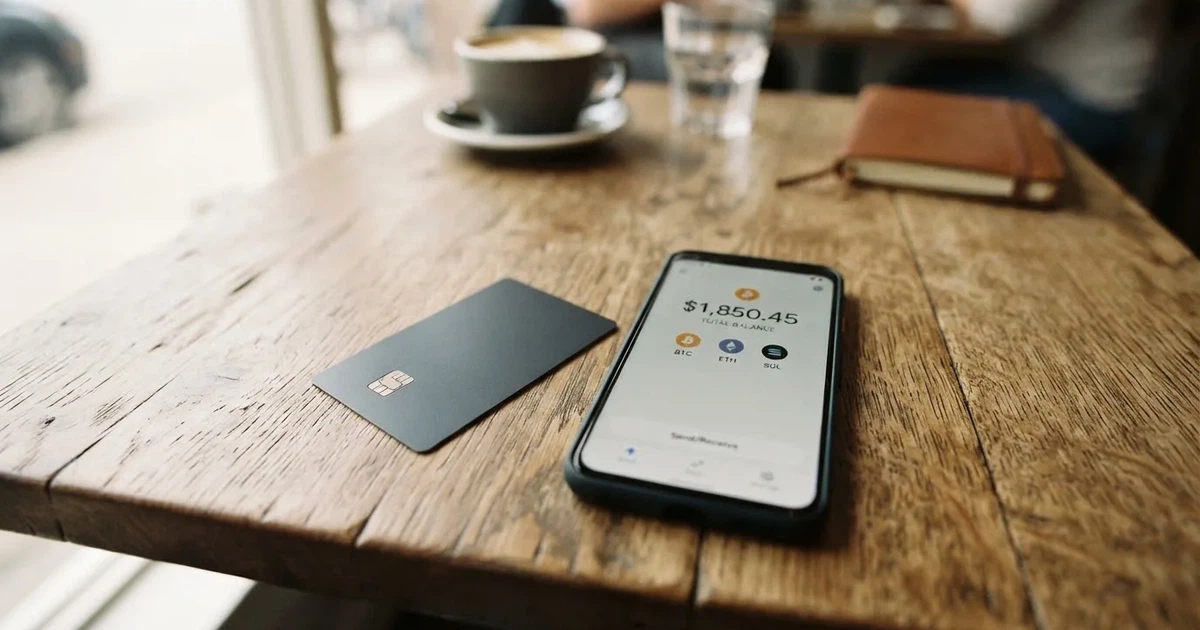
That is the good half. The other half: the card does not support a PIN, cash-machine withdrawals cost 2%, the list of limits and fees comes to me from a terms document that may not even match the card being offered now, and behind it sits an issuer that Exodus only bought in May 2026 and that has reportedly been told it cannot issue cards to new European customers. New US issuance is not open.
I gave it 6.8 out of 10. Not a bad card — a card with one foot in crypto-native convenience and the other foot in ordinary banking, and the banking foot is the one that is wobbling.
*Conditions and figures are current as of October 28, 2026.*
The score in full
| Criterion | Mark | Why |
|---|---|---|
| Who can get it | 7 / 10 | Supported in 42 countries: Europe, Canada, USA (excluding Vermont), Mexico, Brazil, Argentina, Colombia and others |
| Cost | 7 / 10 | Free tier $0 a year; 1% for use outside the cardholder’s country on Free; ATM 2%; stablecoin in a currency other than the cardholder’s 0.5% |
| Top-up options | 9 / 10 | USDT and USDC across several networks — USDC on Solana, Ethereum, Arbitrum One, Base, BNB Smart Chain, Polygon; USDT on Arbitrum One, Solana, Ethereum, BNB Smart Chain, Polygon — plus a bank card and Apple Pay |
| Reliability and complaints | 5 / 10 | Issuer Monavate Ltd (FCA) and operator Baanx, both acquired by Exodus on 1 May 2026; Monavate reportedly unable to issue cards to new European customers, 25% workforce cut; Trustpilot shows Exodus at 4 out of 5 across thousands of reviews |
| Everyday use | 6 / 10 | Virtual and physical Metal card, ATM at 2%; Apple Pay is described for topping up, wallets for paying by card are not disclosed, the card does not support a PIN |
The total is 6.8. The single highest score in the table is top-up (9) and the lowest is reliability (5), and that gap tells the story of the card better than any paragraph: the crypto side is well built, the card-programme side is still finding its feet.
Who this suits. If you already hold USDT or USDC, you already use a self-custody wallet, you are in one of the supported countries, and you want a card that spends that balance without you having to sell to a bank’s account first, this is a sensible pick. The best candidates are Exodus wallet users in Europe and Latin America, where the country list and the two-network deposit routes line up with how people actually hold funds.
Who this does not suit. If you need a PIN, if you take out cash more than occasionally, if you are in the United States and want a card issued today, or if you want to know exactly what a given transaction will cost before you make it — the public pages do not give you that. If your priority is a card that answers to a bank you can phone, this is not it.
Will they give you the card?
They will, but only in a fixed list. Exodus Pay works in most jurisdictions; the Exodus card is supported in Andorra, Argentina, Austria, Belgium, Bosnia and Herzegovina, Brazil, Bulgaria, Canada, Colombia, Croatia, Cyprus, Denmark, Finland, France, Germany, Gibraltar, Greece, Guatemala, Hungary, Iceland, Ireland, Isle of Man, Italy, Jersey, Liechtenstein, Lithuania, Luxembourg, Malta, Mexico, Netherlands, Niger, Norway, Poland, Portugal, Romania, Slovakia, Slovenia, Spain, Sweden, Switzerland, USA (excluding Vermont) and Uruguay.
That is 42 places. Read the list for your own country rather than assuming — it is not “most of the world”, it is a specific set, and Vermont is carved out of the United States, which is the sort of detail that usually has a story behind it.
One thing the card does *not* state clearly is whether citizenship matters the way residence does. The pages give you a country list and nothing about nationality rules, so if you live in one listed country and hold a passport from another, you have a genuine question the marketing copy does not answer.
What you do get in the way of certainty: it is a debit card, not a credit card, usable wherever Mastercard is accepted. There is a virtual card and a physical Metal card. The issuer is Monavate Ltd, an FCA-authorised e-money issuer, and the programme manager is Baanx, per the EU and UK terms. That structure — a regulated e-money issuer underneath, a crypto brand in front — is the standard arrangement for this whole category, and it is worth holding in your head as you read the fees and the risks sections below.
How to get it
Expect to be verified. Identity verification is required for the card, for cash deposits and for redeeming points. The sequence described is: a phone number that receives a code by WhatsApp or SMS, then email verification, then an ID check in the app. Former Spend Card users migrate without re-verification, which matters if you were one of the earlier users.
Beyond that, the public pages go quiet. Verification levels, how long the checks take, what gets a person rejected — not stated. That is a real gap. If your name or your documents do not match neatly, you are finding out at KYC rather than in a table, and KYC rejection is the single most common place where “supported country” quietly stops being true for one person.
On the physical side: the Free tier has no physical replacement card — that is listed as not applicable, which is how the terms say there isn’t one. The Metal card can be replaced for $99, and delivery is expected 6–8 weeks after purchase, to the same country list. There is also a virtual card available alongside, which is the fast route and the one I would use first while a physical one is in transit.
Fees: what it really costs
Here is the honest problem with pricing this card. The detailed fee and limit material comes from the “Exodus Card EU+UK Terms” — a Baanx-era document, file dated 202509, PDF modified 30 April 2026, which may not fully match the newer Exodus Pay card described in the country and network material. And several individual items are simply not stated: the overall cost figure, the ATM terms in the newer article, the specific conversion fee amounts.
So the numbers below are real numbers from real documents, but they may describe a card one generation behind the one being signed up for. Read them as the shape of the pricing, not as a guaranteed quote.
| Fee or limit | Free tier | Metal tier |
|---|---|---|
| Annual subscription | $0 | $199/year, auto-renews, cancellable within 14 days for a refund |
| Purchase limit | $10,000/tx, $15,000/day | $20,000/tx, $30,000/day |
| Card purchase limit (newer material) | 9,500 USD daily, global | 15,000 USD daily, United States |
| ATM limit | $1,000/day | $1,000/tx, $5,000/day |
| ATM fee | 2% | No fee up to $1,200/month, then 2% |
| Foreign transaction | 1% | None, fair use |
| Metal card replacement | Not applicable | $99 |
| Metal card delivery | — | 6–8 weeks after purchase |
Three everyday payments, and which fees actually touch them:
- Buying lunch in the country you live in, in local currency. This is the clean case. You are spending your own balance, the terms say the card is non-US-denominated in local currency, and there is no conversion for you to pay. The ATM and cross-border lines do not apply.
- Buying something priced in dollars from a European shop. Purchases in other currencies are converted from USD at the card network and payment processor rate at the time of purchase — the fee *amount* is not stated. On the Free tier the 1% cross-border line is the number to hold on to; the terms say neither Baanx nor Exodus charges an additional currency conversion fee, and Mastercard converts at its wholesale rate. That sounds generous until you remember the newer article describes the same thing differently, which is exactly the documentation problem I flagged a moment ago.
- Taking cash out of a machine. 2% on Free, and the ATM operator may charge on top of that. On Metal, free up to $1,200 a month, then 2%. If you withdraw regularly, the Metal tier pays for itself on this line alone — and if you never withdraw, you are paying $199 a year for cashback and a metal object.
Two more fees worth knowing about, both from the terms: stablecoins in a currency that is neither the cardholder’s nor the merchant’s cost 0.5%, and other tokens such as wETH cost 0.875%. DeFi or yield tokens are free up to $1,200 a month, then 0.5%. Network gas for your own deposit is a small variable cost, typically $0.01, and that is the chain charging you, not Exodus.
Top up
This is where the card is genuinely strong, and the reason I scored it 9 rather than lower.
The card draws from the Exodus Pay balance on Solana, in this order: USDT, then USDC, then XO Cash. A purchase has to be covered by a single asset — you cannot, for instance, have part USDT and part USDC and split one payment between them. That is a small thing that catches people out.
Deposits come in wide: USDC on Solana, Ethereum, Arbitrum One, Base, BNB Smart Chain and Polygon; USDT on Arbitrum One, Solana, Ethereum, BNB Smart Chain and Polygon. You can also add money by debit card, and by Apple Pay on iOS. The fees on those two pay-side options are not stated, which is the one gap in an otherwise excellent section.
The terms say deposits carry no fee and no minimum balance. Network gas is the small variable cost you pay the chain.
One structural point that saves a lot of confusion: with the self-custody model there is nothing to withdraw from the card, because your funds stay in the linked wallet. Refunds go back to the Card Account and may be unavailable for up to five days. If you close the Card Account, you can request a check of the remaining Card Account balance — for a fee.
When you are topping up, the network matters more than the amount. Blockchain transfers are irreversible, so a deposit sent on a network the card provider does not support, or to an address belonging to a different network, can be lost or need manual recovery with no guarantee. USDC and USDT on the networks listed above will do.
Paying with it every day
The shape of the day-to-day is: virtual card in your wallet, physical Metal card when you want one, Apple Pay for adding money. What you will not find is a disclosure of which mobile wallets work for *paying* — the pages describe Apple Pay for topping up, and the card payment wallet support is not disclosed.
The absence that will bite hardest is the PIN. The card does not currently support a PIN. At terminals that ask for one, you may be able to confirm without entering anything, which means some card-present payments work and others may not, and the shop rather than you decides which is which.
Cashback exists on the Metal tier: 3% on the first $10,000 spent per year, then 1%. Note that the rewards programme may be paused or terminated under the terms — it is listed in a schedule of things that can change, which is worth knowing before you spend on the strength of it.
There is also a regional offer, from a July 2026 press release: card holders in Argentina, Brazil, Mexico, Colombia and Uruguay can pay DGO and SKY+ subscriptions, with new customers in those countries potentially offered 25% cashback subject to terms. The general rate is not stated, so I would not assume 25% applies to anything else.
The app itself rates well where it was measured: 4.6 out of 5 on the App Store from 38K ratings, read on 20 October 2026, for iPhone, iPad and Vision. The Google Play rating was not read, so I am not going to characterise it.
If a card like this goes wrong, the terms describe what happens: purchases are refunded as credit to the Card Account, up to five days; your liability for unauthorised transactions is limited to the transaction’s face amount plus fees; and disputes with the programme manager go to arbitration under Delaware law with a class waiver. Chargeback time frames are not stated. Read the arbitration clause carefully if you live outside the United States — it is the part of the terms that most shapes what your remedy actually is.
What can go wrong
The three things I would weigh, in order.
The issuer. This is the headline risk and it is unusual. Exodus Movement completed its acquisition of Monavate Holdings (issuer Monavate Ltd, FCA-authorised) and Baanx on 1 May 2026 — shares acquired from receivers after a W3C loan default, with $175M announced in November 2025. Q2 2026 results mention a 25% workforce cut. The CEO reportedly said Monavate cannot issue cards for new European clients, in the context of a Bank of Lithuania inspection of Monavate UAB in late 2025. And the newer Exodus Pay help article says new US card issuance is not open.
I want to be careful with that last sentence. It comes from a help article, not from a regulatory filing, and I have not independently confirmed it. But a card whose issuer says it cannot issue to new European clients, owned by a company that bought it out of receivership five months ago, is a different proposition from one issued by an established bank. If your plan depends on a second or third card later — a replacement, a Metal upgrade, a card for someone in your household — that is where you would find out.
Support and complaints. On Trustpilot, Exodus sits at roughly 4 out of 5 from about 4,380 reviews, and the company replies to 93% of negative reviews. That is a good rating for this category. But the negative themes are about the wallet, not the card: blocked transactions, high fees, unresponsive support. One user report describes a debit card validation failure that was fixed after escalation. I found no card-specific complaint threads and no Reddit results on the card itself — which cuts both ways, and I would not read silence as evidence that card problems do not exist.
Contact routes are straightforward: for Metal or replacement, the card terms provide a support contact; for the issuer, [email protected]; and there is a toll-free number on the back of the card. Who answers which question depends on which layer your problem is at, and in my experience of these arrangements that distinction costs you an afternoon.
Self-custody, which cuts both ways. The terms describe self-custody: the card spends value from your own wallet, you set a spending limit, you can freeze the card in the dashboard, add or remove wallets, and you are told to report a lost or stolen card immediately. Funds stay in your wallet until the moment of payment. That is a real protection against a provider being compromised. It is also a real transfer of responsibility: key loss, phishing, and clipboard malware that swaps a copied address are now entirely yours. Blockchain transfers are irreversible and a stolen key has no recovery path. And custody has a history too — Mt. Gox, Coincheck and Ronin are the standard examples of what holding funds with someone else has cost people.
One more small thing: stablecoins are not censorship-proof. Tether says it disables tokens in wallets on the OFAC sanctions list and has frozen funds tied to illicit activity. That is the same screen that decides whether you can use this at all.
Insurance on balances is not stated.
What to take instead
If the Exodus card’s weak point is the card programme rather than the crypto side, look at the alternatives on the same weaknesses. All three below I scored in the same pass; the numbers are from that scoring, not adjusted for this comparison.
| Alternative | Score | Where it differs |
|---|---|---|
| MetaMask | 7.1 / 10 | Mastercard, virtual card issued instantly, Metal pre-orderable; Virtual free, Metal $199/year; “minimal fee for each transaction” with the amount not stated, no additional MetaMask fees, no foreign transaction fee; spends from the connected wallet on Linea, Base, Monad, Solana; cashback 1% Virtual, 3% on the first $10,000 on Metal; 45 listed countries with others waitlisted, US/UK sign-ups temporarily closed |
| KAST | 6.1 / 10 | Visa, virtual and physical, up to 10 cards; Standard 0 USD, Premium 1,000 USD/year, Private 10,000 USD/year; stablecoin top-up 0%, USD spend 0%, but non-USD FX 0.5%–1.75% by country and a 0.10 USD fee on non-USD transactions under 25 USD; 1.5% to 3% cashback; residence-based, with ID nationality mattering at KYC |
| Zeal | 6.1 / 10 | Visa, virtual card addable to Apple Pay, accounts in EUR/USD/GBP on Gnosis Pay; no additional FX fee, Visa wholesale rate, but Gnosis Pay fees may apply; up to 4% cashback paid in GNO if you hold GNO in the card Safe; no published fee schedule |
Read that table as three different answers to “what is my weak point”.
If your weak point is instant access, MetaMask issues the virtual card first and lets you pre-order Metal after approval — one card per user, issuer Monavate, card provider Crypto Life. Its cost structure is friendlier in the places that hurt: no annual fee on Virtual, no foreign transaction fee. Its catch is geography and pace: proof of residency required, ineligible regions limit sign-ups rather than spending, and US/UK sign-ups temporarily closed.
If your weak point is the size of the fee table, KAST publishes the most complete fee schedule of the three: 0% stablecoin top-up, 0% card spend in USD, 0% transaction fee, 0% Apple/Google Pay, 0% stablecoin deposits converted 1:1 with no spread. The costs are elsewhere — 0.5%–1.75% FX on non-USD, 0.10 USD on non-USD transactions under 25 USD, 0.50 USD for a declined transaction. Its KYC is also unusually explicit about nationality: if you live in a supported country but hold an ID from a restricted region you may still be ineligible, dual citizens with an ID from a supported country may pass, only your own ID counts, and a VPN does not bypass any of it. Terms say acceptable tokens are currently USDT and USDC, which conflicts with the PYUSD and RLUSD shown in the app — resolve that before you deposit.
If your weak point is knowing what it will cost, Zeal is the honest answer about FX: no additional currency conversion fee, Visa wholesale rate, though Gnosis Pay fees such as ATM may still apply. No fee schedule is published on zeal.app or the App Store, so that is a promise and not a table. It spends in 150+ countries, and the card programme is live in the EU, UK, Brazil, Colombia, Mexico, Japan, Singapore, the Philippines, Indonesia and Thailand, with notes also mentioning Mexico, Colombia and Bolivia. One wallet rule to know: Solana-only wallets cannot withdraw credit.
For completeness, the mechanics behind all of this are worth understanding. A card number starts with a 6- or 8-digit issuer identification number, the BIN, which any merchant can look up — which is exactly why a card issued in one country can look foreign to a shop in another, and why some merchants decline prepaid or foreign BINs. Address verification is mainly offered in the US, Canada and the UK and is generally unavailable for foreign-issued cards, which causes declines. Visa and Mastercard do not issue crypto cards to consumers themselves; they license issuers, and they can suspend a programme. Visa terminated its global agreements with FTX on 13 November 2022, and WaveCrest, a Visa issuer that supplied several crypto brands, was suspended in Europe in 2018.
Regulation is worth one paragraph. In the EU, MiCA — Regulation (EU) 2023/1114 — took legal effect in June 2023, with its stablecoin rules applying from 30 June 2024 and the remaining provisions, including crypto-asset service provider rules, from 30 December 2024. Under Article 48, e-money tokens may be issued only by a credit institution or an electronic money institution. Providers operating under national law could continue only until 1 July 2026 or until they received or were refused a MiCA authorisation. ESMA keeps an interim register you can check a provider against. A card itself is a payment service regulated separately from the crypto side, which is why a crypto card often rests on two licences — and why an EMI’s safeguarding of your funds is not the same thing as a bank deposit guarantee.
Who I would recommend it to
To someone who already uses Exodus, holds USDT or USDC across the networks listed, lives in one of the 42 supported countries, and spends mostly in their own currency. For them the card does something no mainstream bank card does: it spends the balance in their own wallet, with a $0 tier, and tops up from the chains they already use. The 9 out of 10 on top-up options is the honest score, and if that is your priority this is a good card.
I would push someone else to MetaMask if instant access and a Metal card matter more to them than network choice — it scores higher overall, at 7.1.
I would not push the Exodus card at anyone who needs a PIN, plans on regular cash withdrawals, lives outside the list, or wants a card issued in the United States today. And if you are in Europe and the reported inability to issue to new clients turns out to matter in practice, the sensible move is to check the current state of your specific country’s issuance in the app before you commit to anything — including the $199 Metal tier.
The 6.8 is not a verdict against the product. It is a verdict against a young card programme attached to a young ownership change, doing something genuinely good with the money you already hold.
Frequently asked questions
What is the Exodus card?
It is a Mastercard debit card, not a credit card, that spends the balance of a self-custody Exodus wallet linked to it. There is a virtual card and a physical Metal card. Unlike a custodial card, your funds stay in your wallet until the moment of payment. The issuer is Monavate Ltd, an FCA-authorised e-money issuer, and the programme manager is Baanx. Supported in 42 countries, excluding Vermont in the United States.
Is Exodus a bank?
No. Exodus is a crypto wallet company, and the card sits on an e-money licence, not a banking licence. The issuer is Monavate Ltd, an FCA-authorised e-money issuer, with Baanx as programme manager. That matters for your protection: e-money institutions must safeguard customer funds in dedicated accounts or by insurance, but those funds are not bank deposits and may not be covered by a deposit guarantee scheme.
How do I get the Exodus card?
Identity verification is required. You need a phone number that receives a code by WhatsApp or SMS, then email verification, then an ID check in the app. Former Spend Card users migrate without re-verification. The verification levels, how long checks take, and rejection reasons are not stated on the public pages. The Metal card is expected to arrive 6–8 weeks after purchase; the virtual card is the fast route.
Is Exodus card free?
Yes, the Free tier costs $0 a year. The Metal tier is $199/year, auto-renewing, with a refund available if you cancel within 14 days. Metal adds 3% cashback on the first $10,000 spent per year, then 1%, no foreign transaction fees under fair use, and no ATM fee up to $1,200 a month. Free charges 1% for use outside the cardholder’s country and 2% at ATMs.
How do I top up the Exodus card?
The card draws from the Exodus Pay balance on Solana in this order: USDT, then USDC, then XO Cash, and a single purchase must be covered by one asset. Deposits are free with no minimum balance. USDC is accepted on Solana, Ethereum, Arbitrum One, Base, BNB Smart Chain and Polygon; USDT on Arbitrum One, Solana, Ethereum, BNB Smart Chain and Polygon. You can also add money by debit card or Apple Pay on iOS.
Does the Exodus card support Apple Pay?
Apple Pay works for adding money on iOS — that is what the card’s own material describes. What the pages do not disclose is which mobile wallets work for paying with the card, and that is a genuine gap rather than something I have failed to find. The card also does not currently support a PIN, though at terminals that request one you may be able to confirm without entering anything.
What are the Exodus card’s fees and limits?
On Free: $0 a year, 1% for use outside the cardholder’s country, 2% ATM fee, 0.5% on stablecoins in a currency other than the cardholder’s or merchant’s. Limits are $10,000 per transaction and $15,000 a day, with $1,000 a day at ATMs. Newer material gives a 9,500 USD daily card purchase limit globally and 15,000 USD in the United States. Conversion amounts on other currencies are not stated.
Is the Exodus card safe?
The self-custody design is a real protection: funds stay in your wallet, you set a spending limit, and you can freeze the card in the dashboard. But it transfers responsibility for key loss, phishing and clipboard-swapping malware to you, and blockchain transfers are irreversible. Behind the card, issuer Monavate Ltd and operator Baanx were both acquired by Exodus Movement on 1 May 2026, with a reported 25% workforce cut and a reported inability to issue cards to new European clients.
Which countries is the Exodus card available in?
The card is supported in 42 countries and territories: Andorra, Argentina, Austria, Belgium, Bosnia and Herzegovina, Brazil, Bulgaria, Canada, Colombia, Croatia, Cyprus, Denmark, Finland, France, Germany, Gibraltar, Greece, Guatemala, Hungary, Iceland, Ireland, Isle of Man, Italy, Jersey, Liechtenstein, Lithuania, Luxembourg, Malta, Mexico, Netherlands, Niger, Norway, Poland, Portugal, Romania, Slovakia, Slovenia, Spain, Sweden, Switzerland, USA (excluding Vermont) and Uruguay. New US card issuance is not open per a newer help article.
Is the Exodus card worth it?
For someone holding USDT or USDC in Europe or Latin America who spends mostly in their own currency, yes — the $0 tier and the broad network support are hard to match, and top-up scored 9 out of 10. It is worth less if you need a PIN, withdraw cash often, or live outside the country list. If you are spending heavily, the Metal tier’s no-foreign-transaction-fee terms are the reason it pays for itself.
Wallet cards – cryptocardsearch.com
Content created by the «cryptocardsearch.com» team